
What Is Hydro Jetting
Hydro jetting is a drain and sewer cleaning method that uses a high-pressure stream of water to break up and flush away blockages, grease, scale, tree roots, and debris inside pipes. A licensed plumber inserts a steel-reinforced hose with a specialized nozzle into the pipe through a cleanout access point. Water is then pumped through the hose at pressures ranging from 1,500 to 4,000 PSI, depending on the pipe material, diameter, and the type of buildup being removed.
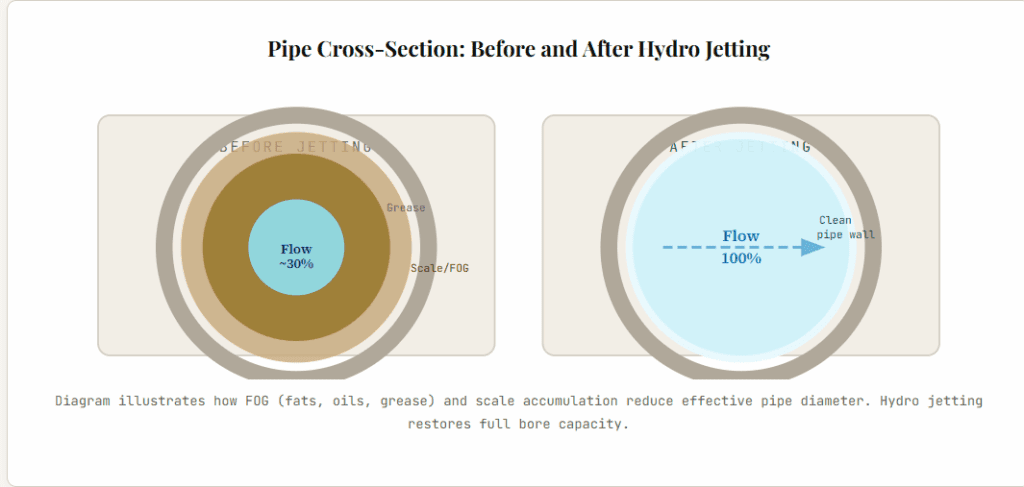
Unlike a drain snake, which punches a hole through a clog and leaves residue on the pipe walls, hydro jetting scours the full interior circumference of the pipe. The result is a pipe that is effectively restored to near-original flow capacity, not just temporarily unblocked.
Drain Pros Ventura Note: At Drain Pros Ventura, we run a camera inspection before every hydro jetting job. This protects older pipes and ensures we select the correct nozzle type and pressure setting for your specific line. We serve Thousand Oaks, Ventura, Camarillo, Simi Valley, and all surrounding Ventura County communities.
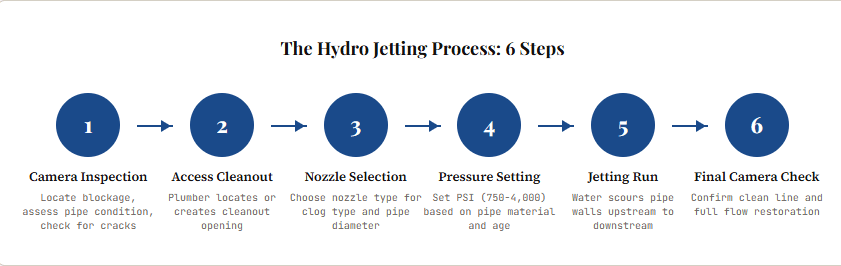
How Hydro Jetting Works: Step by Step
The process is straightforward but requires professional equipment and training. Here is exactly what happens during a standard hydro jetting service call.
Step 1: Camera Inspection Before Anything Else
A trained plumber threads a flexible camera through the pipe to identify the exact type and location of the blockage. This step is not optional. It tells the technician whether the pipe can handle full jetting pressure, whether there are cracks that might worsen, and which nozzle type is best suited to the job.
Step 2: Cleanout Access
The hose and nozzle enter the pipe through a cleanout, a capped fitting installed specifically for maintenance access. If no cleanout exists, the plumber may need to create one, which adds cost but gives you permanent future access.
Step 3: Nozzle Selection
Nozzle choice matters as much as pressure. Different nozzle types handle different problems. A penetrating nozzle punches through grease plugs. A rotating nozzle scours scale from pipe walls. A root-cutting nozzle uses high-speed spinning jets to slice through root intrusion. The plumber matches nozzle to problem type.
Step 4: Pressure and Flow Rate Setting
The machine is set to the correct pressure and gallons-per-minute (GPM) flow rate. Residential drain lines typically receive 1,500 to 2,500 PSI. Main sewer lines and commercial pipes often receive 3,000 to 4,000 PSI. Higher GPM pushes debris further and faster through the line.
Step 5: The Jetting Run
The hose is fed upstream into the pipe, then pulled back slowly as water blasts in all directions from the nozzle. This backward-motion approach means the debris is always being pushed toward the main sewer, not deeper into the system. The combination of pressure and flow volume physically scrapes and flushes everything from the pipe walls.
Step 6: Verification Camera Run
The camera goes back in to confirm the pipe is clear. A professional job ends with video evidence that the line is clean, not just an assumption that the water is flowing again.
Pressure and Flow: The Technical Picture
Understanding the relationship between PSI, GPM, and pipe diameter helps clarify why hydro jetting outperforms other methods on heavy buildup. The data below comes from industry standards published by the Plumbing-Heating-Cooling Contractors Association (PHCC) and WaterJet Technology Association (WJTA).
How Much Does Hydro Jetting Cost
The national average for a residential hydro jetting service falls between $300 and $600 for a standard drain line. Sewer main lines and commercial jobs cost more because they require higher pressure equipment, longer run times, and often a camera inspection both before and after. Here is a breakdown by job type.
If you would like a more detailed look at hydro jetting pricing, including what affects the cost and what homeowners typically pay, read our guide on Hydro Jetting Cost. Heavy mineral scale may require a more targeted cleaning approach. If your pipes have significant buildup, learn more about pipe descaling and the costs involved in removing mineral deposits from the inside of the pipe.
| Service Type | Cost Range | Description |
|---|---|---|
| Kitchen / Bath Drain | $150–$300 | Single line, grease or soap buildup, shorter run |
| Main Residential Sewer | $300–$600 | Full sewer line, typical 3–6 inch diameter |
| Sewer with Root Intrusion | $500–$900 | Includes root-cutting nozzle, longer run time required |
| Commercial / Restaurant | $500–$1,500 | High-grease lines, large diameter, code compliance |
Cost Factors That Move the Price: Access difficulty (no existing cleanout adds $200 to $500 for installation), pipe length beyond 100 feet, severity of blockage, local labor rates, and whether a camera inspection is bundled or separate all affect the final price. In Ventura County, our team provides upfront written estimates before any work begins.
How Much Does Hydro Jetting a Sewer Line Cost Specifically
A residential sewer line (the main line running from your house to the municipal connection) typically costs $300 to $600. This range assumes a standard 50 to 100 foot line with grease and scale buildup. If roots are involved, expect the job to land in the $500 to $900 range because root-cutting nozzles require slower pulling speeds and more passes. A post-job camera inspection, which confirms success, adds $100 to $250 if not bundled into the initial quote.
Hydro Jetting vs. Snaking: Which One Do You Actually Need
Both methods clear blocked drains, but they work differently and produce very different results. A drain snake (also called an auger) is a metal cable that drills or hooks through a clog. Hydro jetting blasts the entire pipe interior clean. Here is when each one makes sense.
| Factor | Drain Snaking | Hydro Jetting |
|---|---|---|
| Cost | $75 – $250 | $300 – $600+ |
| Grease / FOG removal | Punches hole, leaves residue | Full circumference scour |
| Root clearing | Cuts small roots | Slices and flushes roots |
| Scale / mineral buildup | Cannot remove scale | Breaks up and flushes scale |
| Pipe wall cleanliness | Spot fix only | Near-original condition |
| Safe for old clay pipes | Generally yes | Requires camera check first |
| Recurring blockages | Likely to recur sooner | Longer interval before next service |
| Best for | Simple clogs, soft debris, quick response | Grease buildup, roots, recurring blockages, commercial use |
Drain Pros Recommendation: For a first-time blockage with no history of recurring clogs, snaking is a reasonable and lower-cost starting point. But if you have called a plumber for the same drain more than once in two years, or if you run a commercial kitchen, hydro jetting is the right investment. It fixes the root cause, not just the symptom.
Is Hydro Jetting Safe for Old Pipes
This is one of the most common questions we hear from homeowners in older Ventura County neighborhoods where homes were built in the 1950s through 1970s with cast iron, galvanized steel, or clay sewer lines. The honest answer is: it depends on the pipe condition, and that is exactly why a camera inspection before jetting is not optional.
Pipe Material Safety Guide
| Pipe Material | Age Range | Hydro Jetting Safety | Notes |
|---|---|---|---|
| PVC / ABS | 1980s to present | Safe at full pressure | Modern plastic pipes handle 3,000–4,000 PSI without issue |
| Cast Iron (sound) | 1940s–1980s | Safe if no corrosion | Camera inspection required; corroded sections can fail |
| Clay / Terracotta | Pre-1960s | Lower pressure required | Use 1,000–1,500 PSI; avoid penetrating nozzles on fractured sections |
| Galvanized Steel | 1950s–1970s | Inspect closely first | Interior corrosion may weaken pipe; use gentle settings only |
| Orangeburg | 1940s–1960s | Not recommended | Tar paper composite; high risk of collapse under pressure |
| Copper | Any era | Safe at moderate pressure | Typically used in water supply lines; 1,500–2,500 PSI range |
When to Avoid Hydro Jetting: If camera inspection reveals active cracks, collapsed sections, severe root damage that has shifted pipe alignment, or Orangeburg pipe, do not jet. The water pressure will worsen the damage. In these cases, pipe lining, pipe bursting, or full sewer replacement is the right path forward. Drain Pros Ventura will always show you the camera footage and explain your options before proceeding.
Want to learn more about when hydro jetting is safe and when another solution may be the better choice? Read our hydro jetting safety guide for a detailed explanation.
Can Hydro Jetting Damage Pipes
Yes, it can, under specific conditions. But with a professional inspection beforehand, the risk is very low. Hydro jetting causes damage in three situations: wrong pressure for the pipe material, existing cracks that were not identified before jetting, or using penetrating nozzles on pipes that have already lost structural integrity.
When hydro jetting is low risk:
- Camera inspection done before jetting
- Pipe is PVC, ABS, or sound cast iron
- Licensed plumber selects correct PSI
- No pre-existing cracks or joint separation
- Blockage is grease, scale, or soft debris
- Technician uses correct nozzle type
When damage risk increases:
- Orangeburg or severely corroded pipe
- Existing cracks or joint offsets present
- Full pressure on clay pipe without inspection
- Untrained operator with DIY equipment
- Pipe has already collapsed partially
- No camera verification before jetting
The takeaway is that hydro jetting damage is almost always the result of skipping the camera inspection or misdiagnosing the pipe condition. A qualified plumber who follows the correct process does not damage pipes.
Is Hydro Jetting Worth It
For most homeowners dealing with recurring blockages or heavy grease buildup, yes. The comparison that matters is not hydro jetting cost versus snaking cost. It is hydro jetting cost versus the total cost of repeated service calls, emergency drain cleaning, and the slow drain frustration that compounds over time.
The Long-Term Cost Case
Consider a home with a kitchen drain that gets snaked every six months at $150 per call. Over three years, that is $900 spent on a drain that is never truly clean. One hydro jetting service at $350 to $500 clears the pipe completely and resets the clock for one to three years. The math is not complicated.
3-Year Cumulative Cost: Repeated Snaking vs. Hydro Jetting
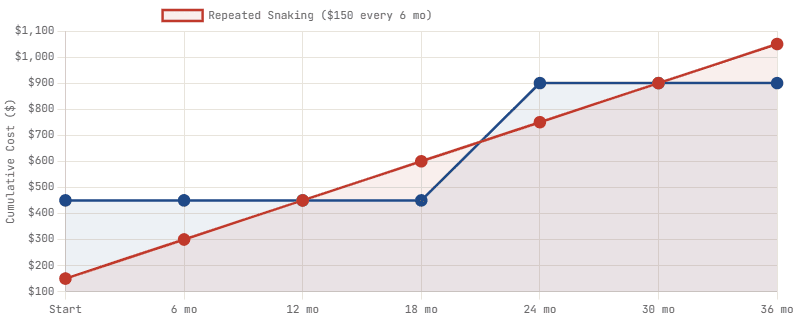
Source: Industry average service call costs; PHCC 2022 homeowner survey data
The Bottom Line on Value: Hydro jetting is worth it when you have recurring clogs, grease buildup from a kitchen line, root intrusion that snaking has not resolved, or a commercial property with code-compliance requirements. It is less necessary for a one-time soft blockage that a snake handles cleanly. When in doubt, call Drain Pros Ventura for an honest assessment at 805-791-3954.
How Long Does Hydro Jetting Last
The results of a professional hydro jetting service typically last between one and three years for a residential sewer line, depending on what caused the original blockage and how the pipes are used afterward.
| Blockage Type | Expected Interval Before Next Service | Factors That Shorten It |
|---|---|---|
| Grease / FOG | 1–2 years residential; 3–6 months commercial kitchen | Continued cooking grease disposal down drain |
| Root intrusion | 1–3 years depending on tree proximity | Fast-growing trees, clay or cracked pipe joints |
| Scale / mineral buildup | 2–4 years | Hard water supply, older galvanized pipe |
| General debris | 2–5 years | Flushing non-flushables, large household usage |
How to Extend the Results
Use drain screens in kitchen and bathroom drains. Never pour cooking grease down any drain. Run hot water for 60 seconds after washing dishes. Flush toilets with only toilet paper and human waste. Schedule a camera inspection every two years if you have trees near your sewer line. These habits can double the interval between professional cleanings.
Signs You Need Hydro Jetting Service
Not every slow drain calls for hydro jetting. But certain patterns are reliable indicators that a thorough high-pressure clean is overdue.
| Sign | What It Suggests | Urgency |
|---|---|---|
| Multiple drains slow at once | Main sewer line buildup, not individual fixtures | High |
| Recurring clog in same drain | Residual buildup snaking did not remove | Moderate |
| Gurgling sounds after flushing | Air trapped by partial blockage in main line | Moderate |
| Sewage odor from drains | Organic material decomposing in pipe walls | High |
| Water backing up into tub or shower | Main line blockage downstream of fixtures | High |
| Snaking works but clog returns fast | Thick grease or root issue that needs more than a hole punched through | Moderate |
| Pre-purchase sewer inspection | Preventive cleaning before moving in | Planned |
| Commercial kitchen drain slow | FOG (fats, oils, grease) accumulation on pipe walls | High |
Frequently Asked Questions
Q. What is hydro jetting and how is it different from regular drain cleaning?
Hydro jetting uses pressurized water (1,500 to 4,000 PSI) to scour the full interior circumference of a pipe, removing grease, scale, and debris from the pipe walls. Regular drain cleaning with a snake punches a hole through a clog but does not clean the walls. Hydro jetting restores pipes closer to original capacity while snaking provides a temporary opening.
Q. How much does hydro jetting cost in Ventura County?
In Ventura County, residential hydro jetting typically runs $300 to $500 for a standard sewer line. Kitchen or bathroom drain lines are $150 to $300. Root-cutting jobs and commercial lines start at $500 and can reach $1,500 for large-diameter commercial applications. Drain Pros Ventura provides written estimates before any work begins. Call 805-791-3954 for a same-day assessment.
Q. How long does hydro jetting last?
For residential sewer lines, results typically last one to three years depending on the cause of the original blockage. Grease buildup in a household kitchen drain may require service annually if cooking habits do not change. Root intrusion in a clay sewer line near large trees may recur within 12 to 18 months. With good habits, many homeowners get two to four years from a single jetting service.
Q. Is hydro jetting safe for old pipes?
It is safe for most older pipe materials when a camera inspection is done first and the correct pressure settings are used. Cast iron in sound condition handles hydro jetting well. Clay and Orangeburg pipe require lower pressures or may be contraindicated entirely if they have existing cracks. A camera inspection before jetting eliminates guesswork and protects your pipes.
Q. Can hydro jetting damage pipes?
Yes, if used incorrectly on the wrong pipe or without a prior inspection. Orangeburg pipe, severely corroded cast iron, or pipes with active cracks can be worsened by high-pressure water. Proper practice eliminates this risk: inspect first, set correct pressure, use the right nozzle type. At Drain Pros Ventura, camera inspection is always part of our process.
Q. Can I do hydro jetting myself?
Consumer-grade pressure washers reach 2,000 to 3,500 PSI, but they lack the flow rate (GPM), proper drain nozzles, and flexible high-pressure hose needed for sewer line jetting. DIY attempts without a camera inspection first can cause serious damage to older pipes. Professional hydro jetting equipment costs $15,000 to $30,000 and requires trained operators. This is not a DIY job.
Q. Does hydro jetting remove tree roots?
Yes, with a root-cutting nozzle that uses high-speed spinning jets to slice through roots. However, jetting removes roots that have entered the pipe but does not address the source. If the pipe has significant joint offsets or cracks that allowed root entry, those structural issues need repair to prevent rapid re-intrusion. Jetting buys time; pipe repair solves the problem long-term.
Q. How long does a hydro jetting service take?
A standard residential sewer line typically takes one to two hours including camera inspection, jetting, and post-job verification. More complex jobs with heavy root intrusion, long pipe runs, or multiple access points can take three to four hours. Commercial projects vary widely based on pipe diameter and line length.
Hydro Jetting Services in Ventura County
Drain Pros Ventura has been clearing sewer lines across Ventura County with professional hydro jetting equipment since the company was founded. Our team works across Thousand Oaks, Ventura, Camarillo, Simi Valley, Oxnard, Westlake Village, Moorpark, Newbury Park, Oak Park, Agoura Hills, Calabasas, and surrounding communities.
Why Ventura County Homes Need Hydro Jetting
A large portion of Ventura County’s housing stock was built between 1955 and 1985. Many of these homes have clay or cast iron sewer lines that are now 40 to 70 years old. These older pipes accumulate scale, develop root intrusion from mature trees, and have joint separations that allow soil infiltration. Standard snaking does not address any of those conditions. Hydro jetting combined with a camera inspection is the professional standard for these pipe types.
Commercial properties and restaurants in the Ventura County area are also subject to California Regional Water Quality Control Board grease management requirements. Regular hydro jetting of grease interceptors and kitchen drain lines keeps you in compliance and avoids citation fines.
Serving All Ventura County Communities: Thousand Oaks, Ventura, Camarillo, Simi Valley, Oxnard, Westlake Village, Moorpark, Newbury Park, Oak Park, Agoura Hills, Calabasas, Chatsworth, Woodland Hills, West Hills, Santa Clarita, Santa Paula, San Buenaventura, and surrounding areas.