
Few home repairs cause as much worry as a damaged sewer line. Beyond the mess and the smell, homeowners want a straight answer to one question: how much will this cost?
The truth is that sewer line repair cost varies widely based on what caused the damage, how deep the pipe sits, and which repair method a plumber uses. This guide walks through real price ranges, the factors that raise or lower your bill, and how a company like Drain Pros Ventura approaches each job.
The short answer: Most sewer line repairs cost between $150 and $3,800. Simple clogs sit near the low end. Broken pipe sections and trenchless liners sit near the top.
A repair fixes the specific section that failed and leaves the rest of the pipe alone, which usually saves thousands compared to a full replacement.
Average cost of sewer line repair by type
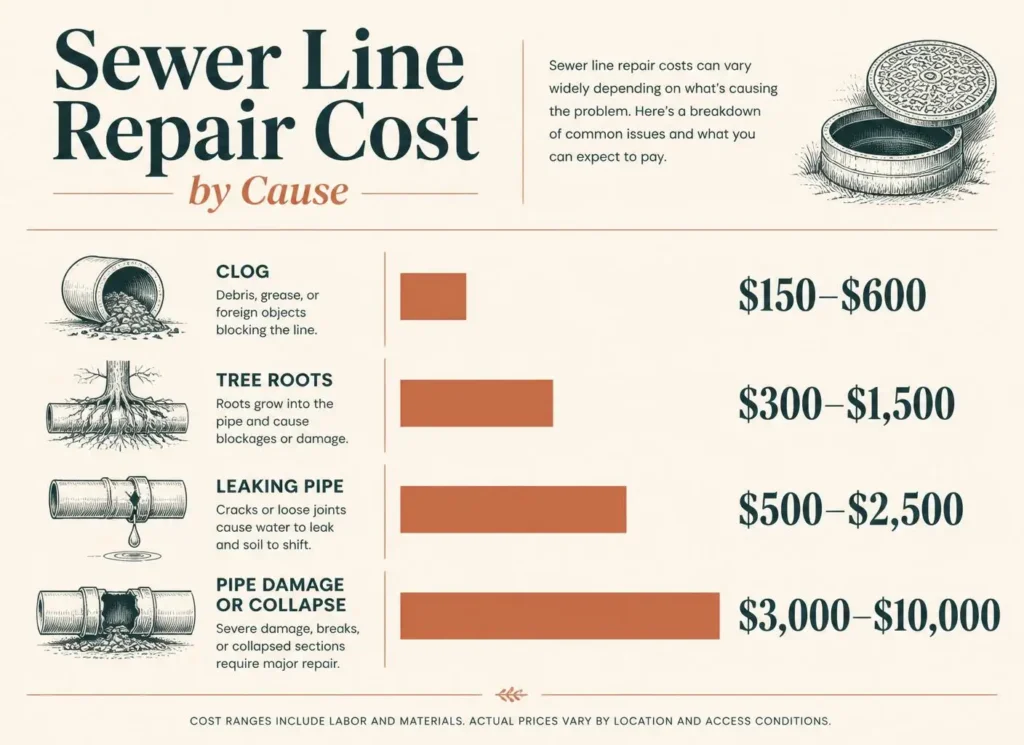
There is no single number that fits every home. The average cost of sewer line repair depends heavily on the root cause of the problem. Here is a breakdown based on common issues plumbers see.
| Repair Type | Description | Typical Cost Range |
| Clogged line (snaking or jetting) | Grease, paper, minor debris | $150 – $600 |
| Tree root intrusion removal | Mechanical cutting or root foam | $300 – $1,500 |
| Small leak or spot fix | One damaged joint or crack | $500 – $2,500 |
| Broken or collapsed section | Single break or short collapse | $3,000 – $10,000 |
| Sewer line belly (sagging pipe) | Requires re grading the soil | $4,000 – $12,000 |
| Full trenchless replacement | When the whole line is beyond repair | $5,000 – $15,000 |
These figures show why a proper inspection matters before anyone gives you a firm number. The cost can shift by thousands depending on pipe depth, material, and access.
Sewer line repair cost breakdown by cause
Clogged sewer line repair cost
A blocked line is the most common and usually the least expensive issue to fix. The clogged sewer line repair cost often stays low if the clog sits near the main cleanout and is caused by grease, paper products, or minor debris. Hydro jetting clears stubborn buildup and restores full flow without digging.
If the blockage causes wastewater to flow back into sinks, tubs, or toilets, learn more about sewer backup repair cost and the factors that affect emergency repair pricing.
Tree root sewer line repair cost
Roots are drawn to the moisture inside sewer pipes and can crack or fully block a line over time. The tree root sewer line repair cost depends on how far the roots have spread and whether the pipe itself was damaged. Small intrusions are cut out mechanically, while extensive root damage may require sewer lining or replacement of that pipe section.
Broken sewer line repair cost
A cracked or fully broken pipe is more serious and more costly. The broken sewer line repair cost rises with depth and location, especially if the break sits under a driveway, patio, or mature landscaping. Trenchless pipe bursting can often fix a break without tearing up the entire yard.
Sewer line belly repair cost
A belly forms when a section of pipe sags and creates a low point where waste and water collect instead of draining away. The sewer line belly repair cost tends to run higher because the surrounding soil usually needs to be excavated and properly compacted to prevent the problem from returning.
Sewer line leak repair cost
Leaks are sometimes harder to spot since water may seep into soil instead of surfacing right away. The sewer line leak repair cost depends on whether the leak is a small crack that can be sealed or a larger split that requires replacing a section of pipe.
Cost by repair method
The method a plumber picks has the biggest single effect on the final bill. Here’s what each common repair method typically costs.
| Repair Method | Description | Typical Cost Range |
| CIPP lining (per foot) | Cured in place liner, no digging | $80 – $250 per ft |
| Pipe bursting (per foot) | New HDPE pulled through the old pipe | $60 – $200 per ft |
| Spot repair | One damaged section | $500 – $2,500 |
| Snaking | Soft clogs and blockages | $150 – $600 |
| Hydro jetting | Grease, scale, small roots | $350 – $900 |

Trenchless vs. traditional repair
Traditional repair means digging a trench to reach and replace the damaged pipe. It is often necessary for severe breaks or when a belly requires regrading the ground underneath.
Trenchless methods, including pipe lining and pipe bursting, access the line through small entry points and avoid major digging. Trenchless work often costs more per job but saves money by protecting your yard, driveway, and any hardscaping above the pipe.
[Image: Fig. 5 — Trenchless repair uses two small pits. Traditional repair opens a full trench across the yard.]
Pipe bursting
A bursting head is pulled through the old pipe. It splits the old pipe outward into the soil and drags a new HDPE pipe in behind it. Cost usually runs $60 to $200 per foot. Great for a pipe that has damage along its length but is too far gone for a liner.
CIPP
CIPP stands for “cured-in-place pipe.” A soft, resin-coated liner is inserted into the damaged pipe and cured until it hardens into a new pipe wall inside the old one. Cost is about $80 to $250 per foot. It avoids digging almost entirely and works well when the pipe is cracked but still holding its shape.
Spin-casting
A spinning tool coats the inside of the pipe with a thin cement or epoxy layer. It’s used to reinforce a pipe that’s thinning or has pinhole leaks, not one that’s already broken. Cost is typically $2,500 to $6,000 for a residential section.
Snaking & hydro jetting
Not repairs to the pipe itself, but the fastest and cheapest way to clear what is blocking it. Snaking runs $150 to $600. Hydro jetting uses high-pressure water to strip grease, scale, and small roots off the pipe walls, $350 to $900, and much more thorough. If the pipe is cracked, though, cleaning alone won’t hold.
What determines the cost to repair sewer line damage
Several variables combine to set your final cost to repair sewer line issues. Understanding them helps you read a quote with confidence.
Labor
Labor is the highest single cost on most jobs. A shallow pipe with easy access might take a two-person crew half a day. A deep pipe under a driveway can take a full crew several days. Labor rates run roughly $50 to $200 per hour depending on your city.
Pipe materials
Modern PVC is the cheapest and most common material. HDPE, used for pipe bursting, costs a bit more but handles ground movement well. Older clay or cast iron pipe often costs more to repair than modern PVC because it cracks more easily and may have multiple weak spots. Material choice can add $500 to $2,000 to the total.
Traditional vs. trenchless digging
Traditional digging is cheaper per foot for the pipe itself, but you pay it back in restoration: new sod, driveway patching, sprinkler repair, fence rebuilds. Trenchless costs more upfront, often by 20 to 40 percent, but leaves your yard mostly intact. On a home with a nice driveway or mature landscaping, trenchless usually wins on total spend.
Other costs
- Depth of the pipe: Lines buried deep require more excavation time and labor.
- Access to the damaged section: Pipes under concrete, patios, or mature trees add cost.
- Length of pipe affected: A short spot repair is cheaper than a longer damaged run.
- Permits and inspections: Many cities require permits for sewer work, $50 to $500.
- Camera inspection: $150 to $450, often credited toward the repair if you hire the same company.
- Landscaping restoration: $500 to $5,000 for sod, plants, and irrigation repair.
- Driveway or concrete work: $1,000 to $6,000 if the pipe runs under a hard surface.
- Emergency or after-hours service: Adds 25 to 50 percent to the labor rate.
Getting a camera inspection before repair work begins is the best way to get an accurate cost for sewer line repair instead of a rough guess.
Ways to lower your repair cost
- Schedule regular camera inspections to catch small issues before they turn into major breaks.
- Avoid planting large trees directly above or near your sewer line.
- Never pour grease, wipes, or paper towels down drains.
- Address small leaks quickly instead of waiting for them to worsen.
- Ask about trenchless options before agreeing to full excavation.
These habits won’t eliminate every risk, but they reduce the odds of facing the highest end of the repair cost range.
What happens once you call
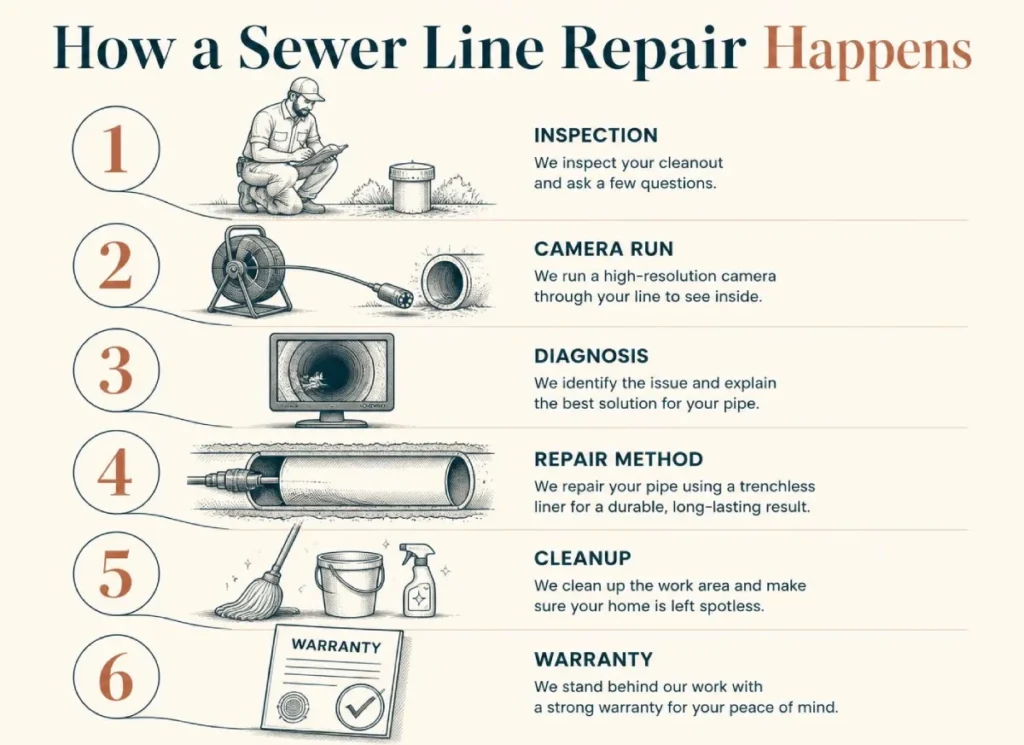
A good sewer repair follows the same path every time: inspection first, then diagnosis, then a repair method matched to what the camera actually shows. Here’s what to expect from the first knock at the door to the warranty paperwork.
Getting estimates from sewer service companies
Always get two or three quotes for anything past a simple clog. A good sewer company will not give you a firm repair price until they have run a camera. If someone quotes a repair without inspecting the pipe, that is a red flag.
At Drain Pros Ventura, we run a full camera inspection before recommending a repair method. This lets us show you exactly where the damage sits and give you options at different price points, so you are never guessing about what you are paying for.
Questions to ask sewer line contractors
- Can I see the camera footage before you give me a final price?
- Is the inspection fee applied toward the repair cost if I hire you?
- What repair method are you recommending, and why?
- Does the quote include cleanup and landscaping restoration, or is that billed separately?
- What warranty comes with the repair, and how long does it last?
- Are you licensed and insured for sewer line work in this area?
- Will you need a permit, and is that fee included in the estimate?
- What happens to the price if you find more damage once work starts?
Sewer line repair FAQs
How much does it cost to repair a sewer line?
Most homeowners spend between $150 for a simple clog and $3,800 for a broken pipe section. The real answer depends on the cause, the depth, and the length of pipe involved.
How much does it cost to repair sewer line breaks specifically?
A single break or crack usually falls in the $3,000 to $10,000 range. The final number depends on whether a trenchless repair is possible or full excavation is needed.
How much does sewer line repair actually cost after all fees are included?
Beyond the base repair, homeowners should budget for inspection fees, permits, and possible landscaping restoration. The total often lands a bit higher than the base repair quote alone.
What’s the cost of sewer line repair if I only need a spot fix?
A spot repair targeting one damaged section is often the most budget-friendly option, usually $500 to $2,500, far less than replacing the entire line.
How long does a sewer line repair take?
A snaking or jetting job takes an hour or two. A spot repair usually finishes in half a day to a full day. Trenchless lining or bursting is often done in one day. Digging and replacing a section can take two to three days plus landscaping restoration.
How do I know if I need a sewer line repair?
Watch for slow drains in more than one fixture, gurgling toilets, sewage smells inside or in the yard, wet or sunken spots above the pipe, and frequent backups. These are common signs you need sewer line repair, while a camera inspection is the only way to know for sure what’s wrong.
Who is responsible for sewer line repair?
The homeowner owns and pays for the “lateral”, the pipe from the house to the city main or property line. The city or water district owns the main. If the damage is on your side of the property line, it is your bill.
Does homeowners’ insurance cover sewer line repair?
Standard policies usually do not cover the pipe repair itself; insurance treats it as wear and tear. Many will cover water damage inside the home from a sudden backup if you have a sewer backup endorsement. Add-on service line coverage (often $30 to $75 a year) can cover the outside pipe.
Final thoughts
Knowing the typical price ranges for each type of damage helps you set a realistic budget and spot a fair quote when you see one.
If you notice slow drains, gurgling sounds, wet spots in the yard, or sewage odors, don’t wait for the problem to grow worse. Drain Pros Ventura is ready to inspect your line, walk you through your repair options in plain language, and help you choose the fix that makes sense for your home and your budget.