

A sewer backup is one of the messiest problems a homeowner can face. Water and waste that should flow away from the house push back into sinks, tubs, or floor drains instead. If it just happened to you, the first question on your mind is probably about money and the sewer backup repair cost you may need to pay.
This guide breaks down the real cost of sewer backup repair, what causes it, and how a plumber like our team at Drain Pros Ventura actually approaches a fix.
The short answer: Most small sewer backups cost between $500 and $2,000. That covers the inspection, clearing the clog, and a basic cleanup.
A collapsed pipe, a full line replacement, or serious water damage costs a lot more. Think of this as the starting point, not the ceiling.
What causes a sewer backup
Before we talk about price, it helps to know why sewer lines fail. Most backups come from one of these problems:
- Tree roots grow into small pipe cracks and slowly block the flow. Once inside, they spread like a net and catch everything that passes by.
- Grease and wipes stick to pipe walls and choke the line over time. Even ‘flushable’ wipes do not break down the way toilet paper does.
- Cracked or collapsed pipe from old age, shifting soil, or ground freeze-thaw cycles. Clay and cast iron pipes are especially prone to this.
- A sagging section (belly) traps waste in a low spot. Water flows through, but solids sit and form a hard blockage.
- A city sewer backup pushes waste back into your home during heavy storms. You cannot stop it, but a backwater valve can block it.
- Foreign objects like toys, jewelry, or hygiene products are flushed by accident. They lodge in bends and start a clog that grows fast.
A single cause can start the problem, but most serious backups involve two or three working together. Roots open a crack, grease sticks to the roots, and the clog keeps growing until water has nowhere to go.
Average sewer backup repair cost
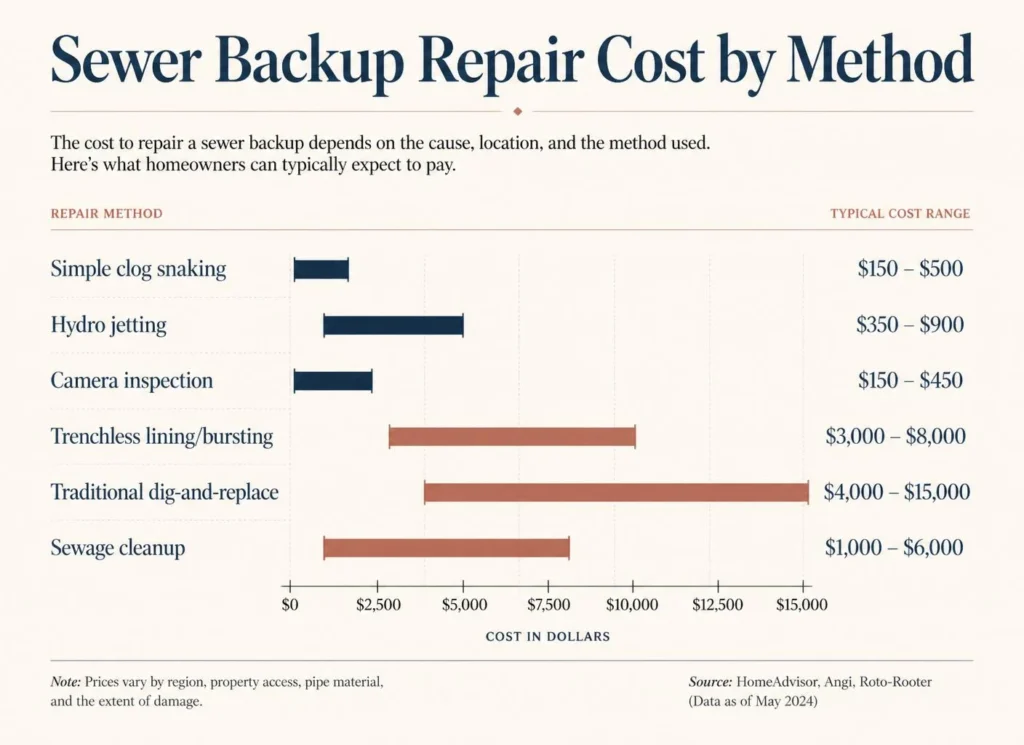
Homeowners often ask, “What is the average sewer backup repair cost?” The honest answer is that it depends on the cause and how far the problem reaches. Still, here are typical ranges plumbers report across the country.
| Repair Type | Description | Typical Cost Range |
| Simple clog (snaking) | Soft blockages, paper, minor grease | $150 – $500 |
| Hydro jetting | Grease, scale, small roots | $350 – $900 |
| Sewer camera inspection | Finds the real problem | $150 – $450 |
| Trenchless lining or bursting | No big trench, saves your yard | $3,000 – $8,000 |
| Traditional dig and replace | For badly collapsed lines | $4,000 – $15,000 |
| Sewage cleanup | Water removal and sanitizing | $1,000 – $6,000 |
A simple clog near the main cleanout is far cheaper than a broken pipe under a driveway. If the inspection finds pipe damage instead of a blockage, the sewer line repair cost depends on the type of damage and the repair method used.
Cost by repair method
The method a plumber picks has the biggest single effect on your final bill. Here is what each common method involves and what it usually costs.
Snaking and augering
A drain snake is a long, flexible cable that pushes through the pipe to break up a clog. It is the fastest and cheapest option, usually $150 to $500, and works well for soft blockages. It will not fix cracks or a collapsed section.
Hydro jetting
Hydro jetting uses a high-pressure stream of water to blast grease, scale, and stubborn debris off the pipe walls. It costs more than snaking, typically $350 to $900, but it clears the line more thoroughly and can cut through small root growth.
Traditional dig and replace
A crew digs a trench along the damaged section, removes the old pipe, and installs a new one. It is reliable and sometimes the only real option, but also the most disruptive, generally $4,000 to $15,000 depending on depth and what sits above the pipe.
Trenchless pipe bursting and sliplining
Trenchless methods work through small access points instead of a long trench. Pipe bursting pulls a new pipe through the old one; sliplining threads a smaller pipe inside the existing one. Both usually run $3,000 to $8,000, and once you count landscaping and driveway repair, they often come out cheaper than digging.
CIPP lining
CIPP stands for “cured in place pipe.” A resin-coated tube is inserted into the damaged pipe and hardened until it forms a new pipe wall inside the old one. Cost is typically $3,500 to $9,000, and it avoids digging almost entirely.
Spin-casting
A lesser-known trenchless method where a spinning tool coats the inside of the pipe with a cement or epoxy lining. It’s mainly used to reinforce thinning pipe walls. Cost is often $2,500 to $6,000, but it’s not the fix for a pipe that’s already broken.
Cleanup and restoration costs
The plumbing fix is only part of the story once sewage has actually backed up into your home. Cleanup usually costs $500 to $3,000 for a small area like a basement floor drain, and can climb toward $6,000 or more if waste spread across a finished basement.
If sewage reached your flooring, drywall, or insulation, that material usually can’t be cleaned and reused. Restoration for a small area runs $1,000 to $3,000, while a larger finished space with carpet and drywall can reach $5,000 to $10,000. This work is billed separately from the plumbing repair.
What changes the final bill
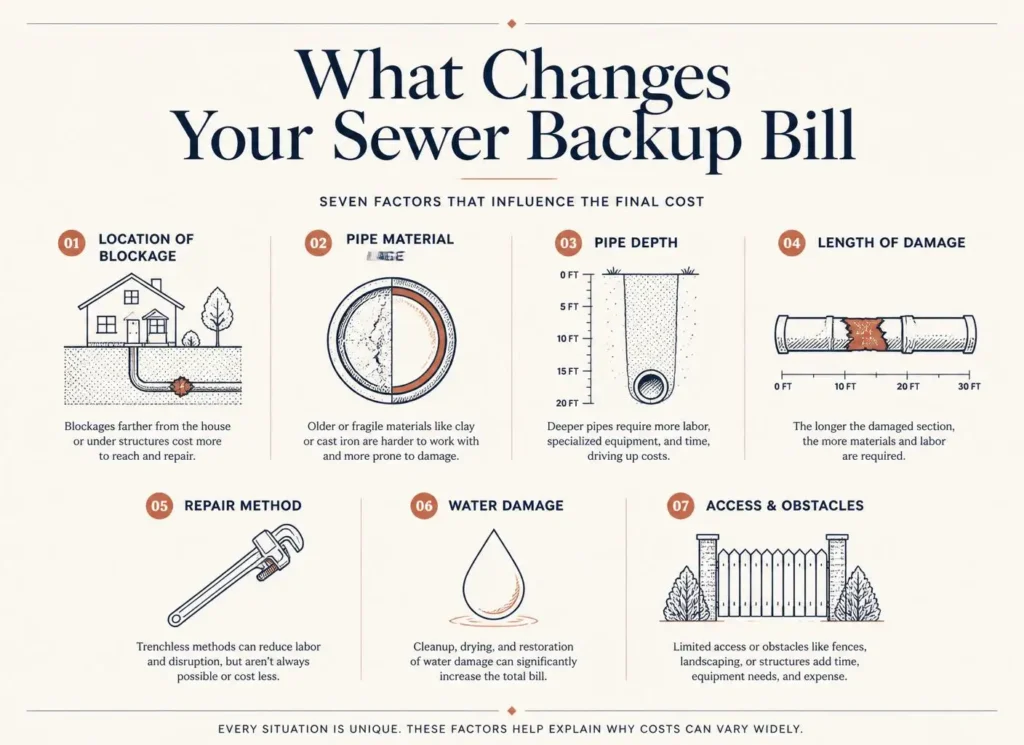
Every sewer backup is different, so plumbers price the job based on what they find. Here are the main things that push the cost up or down.
- Location of the blockage: A clog near the house is quick. A break under a driveway, sidewalk, or mature tree takes far longer and costs more.
- Pipe material and age: Old clay and cast iron crack more easily than modern PVC. Older pipes may also have multiple weak spots, not just one.
- Depth of the pipe: Deeper pipes mean more digging, more time, and more labor. In some areas, the main line sits six feet down or more.
- Length of damaged pipe: A ten-foot crack is a small repair. A fifty-foot collapse may need a full replacement, which multiplies the price.
- Repair method: Trenchless costs more per job but often saves your yard, driveway, and landscaping. Digging looks cheaper on paper until you add restoration.
- Water damage: Cleanup, drywall, flooring, and mold prevention add to the total spend. Insurance may cover some of this, but not the pipe repair itself.
- Access and obstacles: Fences, decks, utility lines, and tight side yards slow the crew down. Anything that blocks equipment raises labor hours.
The best way to control cost is to catch the problem early. A camera inspection every few years spots cracks and root intrusion before they turn into a full backup.
How a plumber actually fixes it
Understanding the process gives you a clearer picture of what you’re paying for. Here’s the general path a licensed plumber follows, from the first phone call to the final test.
- Stop using water, so the backup doesn’t get worse. Every flush or sink run adds more pressure to the clog.
- Find the main cleanout, the capped pipe near the house or in the yard. This is the entry point for cameras and cleaning tools.
- Run a camera inspection to see the exact problem. The video shows cracks, roots, grease buildup, or collapses in real time.
- Clear the blockage with a snake, jetter, or root cutter. The tool choice depends on what the camera found.
- Repair or replace any cracked or collapsed sections. Small cracks may get a liner. A full collapse usually needs a new pipe.
- Test the line by running water through the system. The plumber watches the camera again to confirm the flow is smooth, and the fix is solid.
- Clean and sanitize anything the sewage touched. This step protects your health and prevents mold from growing in floors or walls.
A good crew will also walk you through the camera footage so you see the problem yourself. If a plumber skips the inspection and jumps straight to digging, that is a red flag.
DIY vs. calling a professional
A plunger or a small hand auger can sometimes clear a minor clog in a single fixture. But a true sewer backup usually affects multiple drains at once, a sign the main line is blocked, not just one pipe. Store-bought chemicals can actually damage older pipes and make the problem worse.
Professionals carry cameras, jetters, and root cutters most homeowners don’t own. They also have the experience to diagnose the real cause instead of just treating the symptom. Hiring a pro costs more up front, but it usually prevents repeat calls.
How to prevent the next one
Most backups build up slowly over months or years. The good news is that a few simple habits can keep your line healthy and save you from another emergency call.
- Don’t flush wipes, paper towels, or feminine products, even the ‘flushable’ kind. They do not dissolve like toilet paper and are a top cause of clogs.
- Pour cooking grease into a can, not the sink. Grease hardens as it cools and sticks to pipe walls like wax.
- Schedule a camera inspection every 2 to 3 years, especially in older homes. Catching root intrusion early is far cheaper than replacing a pipe.
- Ask about a backwater valve if your home sits low compared to the street. It closes automatically when city pressure pushes backward.
- Check tree roots regularly if big trees grow near your sewer line. A root treatment every year or two can keep small growth from becoming a full blockage.
- Run water through drains you don’t use often, so traps don’t dry out. Dry traps let sewer gas into the house and can become entry points for debris.
- Install mesh drain screens in showers and sinks. They catch hair and food scraps before they reach the main line.
Think of your sewer line like a car engine. Regular check-ups cost a little, but they prevent the expensive breakdown that happens when you ignore warning signs.
Questions to ask any contractor
Hiring the right plumber matters as much as the repair itself. Ask these questions before you sign anything, and do not feel pressured to decide on the spot.
- Will you run a camera inspection before giving me a final price? A written quote without video is just a guess.
- Is the inspection fee applied toward the repair cost if I hire you? Many companies credit it back, which shows confidence in their work.
- What repair method are you recommending, and why? There should be a clear reason tied to what the camera showed.
- Does the quote include cleanup, or is that billed separately? Sewage cleanup is often handled by a different crew with its own invoice.
- What warranty comes with the repair, and how long does it last? A one-year warranty is standard; five or ten years is excellent for trenchless work.
- Are you licensed and insured for sewer line work in this area? Ask for proof. An uninsured crew puts your home at risk if something goes wrong.
- Will you need a permit, and is that fee in the estimate? Some cities require permits for digging or lining work, and the cost should be clear up front.
- Can you show me photos or video from a similar job? Experienced plumbers keep examples and are happy to share them.
Get at least two quotes for anything over $1,500. The cheapest bid is not always the best; look for clear explanations, written warranties, and a company that takes time to answer your questions.
Final thoughts
A sewer backup is never convenient, but understanding the process and cost ranges puts you in a stronger position. Whether the fix is a simple snake job or a full pipe replacement, working with an experienced team protects your home and your budget.
If you’re dealing with a backup right now, don’t wait. The longer waste sits in your pipes, the greater the risk to your home and your health.