
A clogged drain is one of those problems that starts small and gets bad fast. One day the water drains slowly. A few days later, you are standing in two inches of water in the shower. If you have ever poured chemical cleaner down the pipe and wondered why nothing changed, this guide is for you.
A clogged drain is the number one plumbing complaint in American homes. At Drain Pros Ventura, we have been clearing drains across Thousand Oaks, Ventura County, and the San Fernando Valley for over 20 years. We have seen every clog type, every DIY attempt, and every mistake people make trying to fix things themselves. This guide covers what actually works, what to skip, and when it is time to call a pro.
Why Drains Clog in the First Place
Before you grab a plunger, it helps to understand what you are dealing with. Clogs are not random. They form in predictable patterns, in predictable places, for predictable reasons.
Key Facts
- 35% of all plumbing calls are drain-related
Source: Plumbing Manufacturers International, 2023 - $4.8B spent on drain cleaning services annually in the US
Source: IBISWorld, 2024 - 80% of clogs happen within the first 5 feet of a drain opening
Source: American Society of Plumbing Engineers - 9 out of 10 kitchen clogs involve grease buildup
Source: Roto-Rooter Consumer Report, 2022
The 5 Root Causes
Most common causes of household drain clogs (% of service calls)
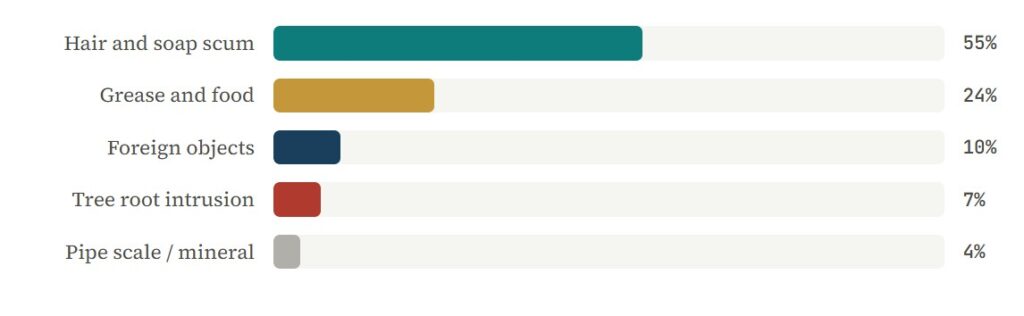
In coastal communities like Ventura, mineral buildup from hard water speeds up clog formation inside older galvanized pipes. If your home was built before 1985 and still has original plumbing, clogs may return faster than the national average even after a professional cleaning.
How to Read the Symptoms
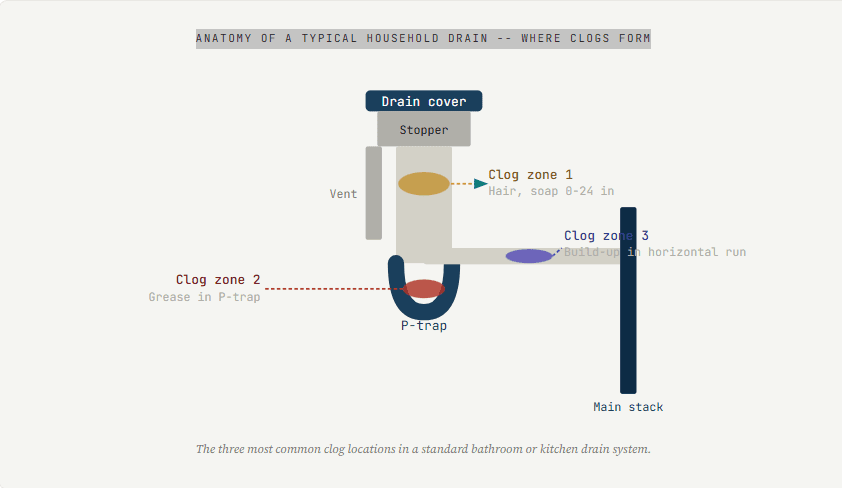
Different clog locations produce different symptoms. Matching the symptom to the source saves you from trying the wrong fix and wasting an hour.
| What you observe | Likely clog location | Severit | First move |
|---|---|---|---|
| Single drain drains slowly | Within first 12 inches (zone 1) | Low | Plunger or hair catcher removal |
| Gurgling after water drains | Partial clog or vent issue | Medium | Baking soda flush, then snake |
| Water backs up into adjacent fixture | Shared branch line (zone 3) | Medium | Drain snake 15+ feet |
| Multiple drains slow at once | Main sewer line | High | Stop water use, call a plumber |
| Sewage smell with no backup | Dry P-trap or venting failure | Medium | Run water to refill trap |
| Sewage backup at floor drain | Main sewer line blockage | High | Emergency call immediately |
Warning: Never ignore multiple slow drains at once. In Ventura, tree roots, especially from older eucalyptus and pepper trees, are a frequent cause of main line blockages. Using chemical drain openers when roots have intruded can crack already stressed pipes. Stop and call a professional before it turns into a sewer emergency.
Tools and Supplies You Need
You do not need a truck full of equipment. For most residential clogs, the right tool for the job is usually something you can pick up at a hardware store for under $30.
- Cup Plunger: Flat bottom. Works on sinks and tub drains. Not toilets, that requires a flange plunger.
- Flange Plunger: Has a rubber flap that folds into the bell for flat drains, or out for toilet use. More versatile.
- Drain Snake (Manual): 25-foot cable that breaks up or hooks clogs 12 to 25 feet into the pipe. Good for most home drains.
- Zip-It Tool: Thin plastic strip with barbs that grabs hair from bathroom drains. Works on zone 1 clogs in seconds.
- Drain Auger (Power): Electric or drill-powered. Handles tough, deep clogs. Rent for large kitchen or laundry line blockages.
- Enzyme Drain Cleaner: Biological formula that digests organic material without corroding pipes. Slow but safe for regular use.
Warning: Chemical drain openers like Drano and Liquid-Plumr, these products use lye (sodium hydroxide) or sulfuric acid to dissolve organic matter. They can warp PVC, corrode older metal pipes, and create a chemical reaction that generates heat inside a blocked pipe, which can crack or warp fittings. If a chemical opener does not clear the clog in one use, stop. Do not add a second application. The chemical pool sitting in a blocked pipe is a hazard for any plumber who follows. Our team at Drain Pros Ventura deals with chemical exposure injuries more than most people realize.
5 Proven Methods to Unclog a Drain (Step by Step)
Start with the easiest methods first. Most simple clogs clear without tools or chemicals. If the first method does not work, move to the next one.
Method 1: The Plunger (Best First Step for Most Clogs)
A plunger uses pressure differentials, not force, to break up soft clogs. Most people use it incorrectly, which is why it often seems ineffective.
Here is the correct technique:
- Seal off overflow openings: On bathroom sinks, plug the overflow hole (the small hole near the top of the basin) with a wet cloth. Without this, your plunging pressure escapes and does nothing.
- Fill with enough water to cover the plunger bell: The plunger needs water to transmit pressure. Dry plunging only moves air. Add enough water to submerge the rubber bell by at least 2 inches.
- Establish a tight seal before pumping: Press the plunger down slowly over the drain to push all air out of the bell. A bell full of air means you are pushing air, not water. You should feel resistance once the seal is set.
- Pump with firm, controlled strokes: Push down and pull up steadily, 15 to 20 strokes per session. The up-stroke is just as important as the down-stroke. Keep the seal intact throughout. Do not bang aggressively; that breaks the seal.
- Test and repeat: On the final up-stroke, break the seal quickly to create suction. Then let water flow and check speed. Repeat 2 to 3 times before switching methods if needed.
Method 2: Baking Soda and Vinegar Flush
This chemical-free method works best on partial clogs and light grease build-up. It is not a magic fix for a full blockage, but it is safe, cheap, and a solid first move for a slow drain.
- Boil a full kettle of water: Pour it slowly down the drain to soften any grease or soap. Do not do this on PVC pipes that may be damaged by boiling water — use very hot tap water instead (around 150 degrees F).
- Pour 1 cup of baking soda: Push it past the drain cover as far as possible. This is your base agent.
- Add 1 cup of white vinegar immediately: The fizzing reaction loosens debris clinging to pipe walls. Cover the drain with a cloth immediately to force the reaction downward rather than back up into the basin.
- Wait 20 to 30 minutes, then flush hot water: Let the reaction work. Then flush again with another kettle of hot water to push the loosened material further down the line.
Tip: Use this method monthly as a maintenance flush rather than waiting for a slow drain. Five minutes once a month prevents the gradual build-up that causes the clogs you call us about on a Friday night.
Method 3: Drain Snake (Manual Auger)
When the plunger does not break it up, the clog is either solid, deep, or both. A drain snake lets you physically reach the blockage and break it up or pull it out, making it one of the most effective methods for snaking a shower drain. This is the single most useful tool for home drain clogs.
- Remove the drain cover or stopper: On bathroom sinks, look for a pivot rod under the sink connected to the stopper. Disconnect it to pull the stopper out. More direct access means the snake works better.
- Feed the snake head into the drain opening: Begin with 6 to 8 inches of cable unspooled. Guide it into the drain, not forced. If it hits resistance immediately, you likely found the clog.
- Rotate the handle clockwise as you push: The rotating action causes the cable tip to bore into or hook onto the clog. Never push without rotating, you will just fold the cable back on itself inside the pipe.
- Feel for changes in resistance: A sudden drop in resistance usually means you pushed through the clog. Spinning freely with no contact further along means you may have passed it. Pull back slowly and feel for something hooked.
Retract carefully and flush immediately: Pull the snake out slowly while rotating. What comes out will be unpleasant. Have a bucket and paper towels ready. Flush with hot water for 2 to 3 minutes to clear any remaining debris.
Method 4: P-Trap Cleaning (Kitchen Sinks)
When grease fully blocks the U-shaped pipe beneath the sink, the P-trap, no amount of plunging will help because the trap is filled with solid material. You need to remove it and clean it by hand. If you’re dealing with a similar blockage, these steps to fix a clogged kitchen sink can help you identify the problem and choose the right approach. This sounds worse than it is.
- Put a bucket under the P-trap: Everything in the drain above the trap will empty when you loosen it. A standard bucket holds more than enough water from a typical sink basin.
- Unscrew the slip-joint nuts by hand: On PVC pipes, these are hand-tight. Metal traps may need channel-lock pliers. Turn counterclockwise. Do not use excessive force on PVC or you will crack the fitting.
- Empty, inspect, and clean the trap: Use an old toothbrush and dish soap to scrub the inside of the trap. Also check the pipe openings above and below, you can often see or reach additional buildup right at the connection points.
- Reinstall and check for leaks: Tighten by hand plus a quarter turn with pliers. Run water for 2 minutes and watch all the slip-joint connections for drips. A small drip means the rubber washer inside needs to be repositioned or replaced.
Method 5: Wet and Dry Vacuum
Underused and highly effective for shallow clogs. A shop vac set to wet mode can suck out hair and debris that a plunger cannot dislodge. Cover the overflow opening, create a seal with an old plunger cup over the drain, then run the vacuum on its highest setting for 30 to 60 seconds.
Note: If your home uses a shared septic system or a community lateral, what seems like an internal clog may actually be a shared line problem. Signs include neighbors reporting slow drains at the same time, or your toilets and showers backing up simultaneously. This is beyond DIY territory. Call us first, we can run a camera in the line to confirm before anyone starts digging.
Specific Guide by Drain Type:
| Drain Type | Primary Clog Cause | Best DIY Method | Tools Needed | Call a Pro If… |
|---|---|---|---|---|
| Bathroom sink | Hair, toothpaste, soap scum | Zip-It tool, then plunger | Zip-It, cup plunger | Clog returns within a week |
| Shower drain | Hair and conditioner buildup | Remove drain cover, pull hair, snake if deeper | Screwdriver, Zip-It, snake | Water stands for 10+ minutes |
| Bathtub drain | Soap scum, hair, toy blockage | Remove overflow plate, plunge with flange plunger | Screwdriver, flange plunger | Drain does not improve at all |
| Kitchen sink | Grease, food scraps, coffee grounds | Baking soda flush, then P-trap cleaning | Bucket, pliers, brush | Garbage disposal side is also blocked |
| Toilet | Waste, paper product, foreign object | Flange plunger, then closet auger | Flange plunger, closet auger | Water level rises to the rim |
| Floor drain | Sediment, debris, root intrusion | Remove cover, clear visible debris | Screwdriver, gloves | Water backs up from it |
| Laundry drain | Lint, detergent residue | Snake 15 to 25 feet | Power auger or long snake | Multiple wash cycles back up |
DIY vs. Professional: How to Decide
We run a plumbing business, so it would be easy for us to say “call a pro for everything.” We are not going to do that. A lot of clogs are straightforward and you will save $150 to $300 by fixing them yourself. But some clogs are signs of something larger, and the wrong DIY move makes them worse.
Handle it yourself when:
- Only one drain is affected
- It started slowly over days or weeks
- You can see or reach the clog source
- The drain responds at all to plunging
- No foul odor from the drain
- No water on the floor or in adjacent fixtures
- The home is less than 30 years old with plastic pipes
Call Drain Pros Ventura when:
- Two or more drains are slow simultaneously
- Any drain backs up after using another fixture
- You hear constant gurgling from the toilet
- Sewage odor is present anywhere in the home
- A chemical drain opener was already used and failed
- The clog has returned more than twice in 90 days
- The home has old galvanized or clay pipes
- Water stains appear below the sink or on the ceiling
Local Note for Ventura and Oxnard homeowners: Homes near creek beds, older neighborhoods in Midtown and East Ventura, and properties along the hillsides often have pipe age and root exposure that makes recurring clogs a structural issue rather than a behavior issue. If you are clearing the same drain every 2 to 3 months, a $79 camera inspection now is cheaper than an emergency line replacement later. We offer this service to all Ventura County, the San Fernando Valley, and the Santa Clarita area customers.
Real Cost Breakdown
Drain clog costs can change a lot depending on how bad the problem is and how deep it is in the pipes. Small clogs near the surface are usually cheap and easy to fix, but bigger or repeated problems can become expensive fast.
Average cost to unclog a drain in Ventura County, 2026:
| Service Type | Estimated Cost (USD) |
|---|---|
| DIY supplies (plunger, Zip-It, baking soda) | $10 – $30 |
| Professional snaking (single drain) | $85 – $175 |
| Professional hydro-jetting (full line clean) | $250 – $600 |
| Camera inspection | $75 – $150 |
| Emergency after-hours service call | $150 – $300 + repair cost |
| Sewer line repair (root damage or collapse) | $1,500 – $6,000+ |
When homeowners call a plumber vs. attempt DIY first (US survey, n=1,200)
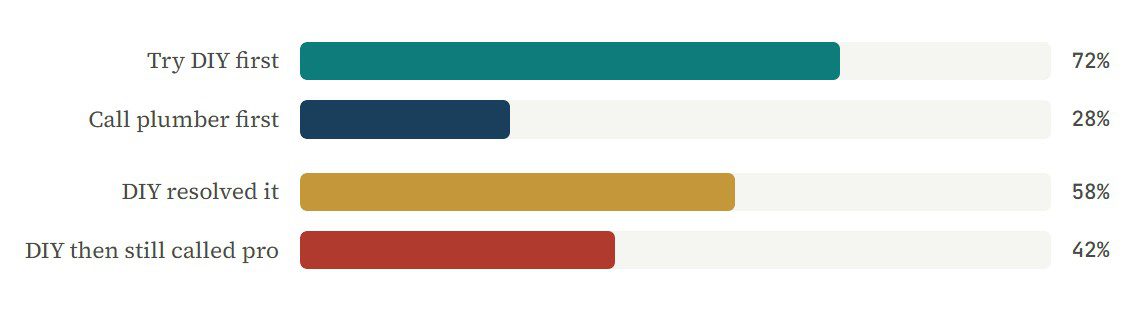
Source: HomeAdvisor True Cost Guide 2024. Of the 42% who called a pro after DIY, the average additional delay increased repair costs by 18% due to pipe stress from repeated plunging and chemical use.
Prevention Schedule That Actually Works
The most cost-effective drain service is the one you never need. Every plumber will tell you this, because it is true. Here is a practical schedule that takes less than 10 minutes a month.
- After every use: Run cold water for 30 seconds after using the garbage disposal. Cold water solidifies fat so the disposal can chop it and move it through. Hot water melts it, which lets it coat the pipe walls downstream and re-solidify.
- Weekly: Remove and clean hair from shower and bathroom drain covers. A 30-second pull with a Zip-It tool after each shower is the single highest-return maintenance habit in residential plumbing.
- Monthly: Baking soda and vinegar flush on kitchen and bathroom sinks. One cup of each, followed by hot water. Keeps organic build-up from reaching blockage thickness. Set a phone reminder the first of each month.
- Every 3 months: Inspect P-traps visually for early discoloration or mineral scale. Open the cabinet under each sink and look at the plastic or metal U-bend. White mineral deposits on PVC are early signs of hard-water scale that will narrow the pipe over time.
- Annually: Professional enzyme treatment or hydro-jetting. Annual hydro-jetting completely clears biofilm and grease from the full length of your drain lines. Think of it like a dental cleaning — you can brush daily and still need a professional clean once a year. In Ventura, we recommend this especially before the rainy season when ground shifting from soil saturation can stress older lateral lines.
What Never Goes Down Any Drain:
| Item | Why it causes problems | Safe disposal method |
|---|---|---|
| Cooking grease or fat | Liquefies when hot, then solidifies in cool pipes; coats walls and can narrow flow by up to 90% over time | Pour into a sealed container or jar, then dispose in trash |
| Coffee grounds | Do not dissolve in water; accumulate in the P-trap in dense, paste-like layers | Compost or dispose in trash |
| Flushable wipes | Do not break down properly in residential plumbing; can clump in sewer lateral lines | Dispose in trash only |
| Eggshells | Membrane binds with grease and debris, forming sticky buildup on pipe walls | Compost or dispose in trash |
| Pasta, rice, bread | Continue absorbing water and swell, forming a dense paste in the P-trap | Trash or compost |
| Medication | Does not clog pipes but contaminates waterways and local water systems | Use pharmacy take-back programs or approved disposal sites |
When it is time to call Drain Pros Ventura
DIY methods work well on simple clogs. But some situations need the right tools and experience to fix safely without causing more damage.
Here is when you should pick up the phone.
- Hydro jetting needed: Years of grease, mineral scale, or root intrusion require high-pressure water jetting that only professional equipment can handle.
- Mystery clogs: Our camera inspection service finds the exact location and cause of any blockage without digging up your yard first.
- Multiple blocked drains: Two or more drains backing up at the same time means the main sewer line is involved. DIY will not fix this.
- Emergency overflows: We offer 24/7 emergency plumbing in Thousand Oaks and across Ventura County. Same-day response, day or night.
- Recurring clogs: If you are snaking the same drain every month, something deeper is wrong. We find the root cause and fix it for good.
- Older homes: Homes in Ventura County built before the 1980s may have clay, cast iron, or galvanized pipes that need careful handling.
Our three-option approach, no pressure, ever
When you call Drain Pros Ventura, we do not show up and hand you one quote for the most expensive fix. We give you three clear options so you can decide what works for your situation and your budget.
- Option 1: Band-aid fix
- Option 2: Temporary repair
- Option 3: Permanent solution
No upsells. No pressure. Just an honest explanation of each option and what it means for your home long term. You choose what fits.
Questions we hear all the time
Can I use a drain snake on a toilet?
Yes, but you need a toilet auger, which is different from a standard drain snake. A regular drain snake can scratch the porcelain bowl and may not have enough reach to do the job. A toilet auger has a protective rubber sleeve and a longer cable designed to move through the toilet’s trap without causing damage.
How do I know if my main sewer line is blocked?
The clearest sign is when multiple drains back up at the same time, or when using one fixture causes water to come up in another. For example, flushing the toilet causes the shower drain to bubble, or running the washing machine causes the toilet to overflow. If this happens, stop using water in the home and call a plumber right away.
What is hydro jetting and do I need it?
Hydro jetting uses a high-pressure stream of water to blast through stubborn blockages and clean the inside walls of your pipes. A drain snake breaks a hole through a clog. Hydro jetting removes the whole buildup from the pipe walls. You likely need it if you have recurring clogs, grease buildup in a kitchen drain, tree root intrusion, or slow drains throughout the home. Drain Pros Ventura uses professional-grade hydro jetting equipment for these jobs.
What does a camera inspection actually show?
Our waterproof camera travels through your pipe and sends a live video feed to a screen on our end. We can see the exact location of a clog, the condition of the pipe walls, any cracks or corrosion, root intrusion, and whether a pipe has collapsed or shifted. This takes the guesswork out of every repair and means we never dig up your yard unnecessarily.
How much does drain cleaning cost in Ventura County?
We provide upfront pricing before any work starts, so there are never any surprises. The cost depends on the type of drain, how deep the clog is, and which method is needed to clear it. Call or text us at (805) 791-3954 for a free estimate. We are straightforward about pricing on every single job.
Do you offer emergency drain service on nights and weekends?
Yes. Drain Pros Ventura provides 24/7 emergency plumbing service across Thousand Oaks, Ventura County, the San Fernando Valley, and Santa Clarita. If you have a drain backing up after hours, call us and we will respond the same day.