
Watch a street during hard rain. Thousands of gallons come off it in minutes. The water runs down roofs and driveways, spreading along the curb. And then disappears through a metal grate into a storm drain. If you have ever stood there in the wet and asked yourself, ‘what is a storm drain, and where does all this go?’ that is what this guide is for. How the system works, how it splits from your sewer, and what it can mean for you as a property owner.
You pass these openings daily. Storm drains sit along the curbs and gutters, and there’s almost always one tucked in the low corner of a parking lot. Under the grate is where the network runs, out of sight.
What Is Stormwater, and Where Does It Go?
Stormwater is the rain and snowmelt that never makes it into the ground.
Out in a field or a garden, soil and roots soak up most of it. Cover that same ground with asphalt or a rooftop and the water has nowhere to go but sideways, fast and all at once. The US Environmental Protection Agency calls the result stormwater runoff, water moving across streets, lots, and rooftops instead of down into the soil.
And it grabs whatever it rolls across. Oil off a driveway. Fertilizer from a lawn. A gutter packed with litter, loose dirt from a yard with no grass on it. None of it gets filtered. It runs straight to the nearest creek or river, and in Ventura County that usually means the Pacific, which is why the state keeps an eye on what turns up in the runoff.
What Is the Purpose of a Storm Drain?
So what is a storm drain doing in the middle of a storm? One job, mostly: get the water off the road before it piles up. Runoff left alone climbs the curb and heads for the nearest low doorway, and that is how garages and ground floors end up underwater.
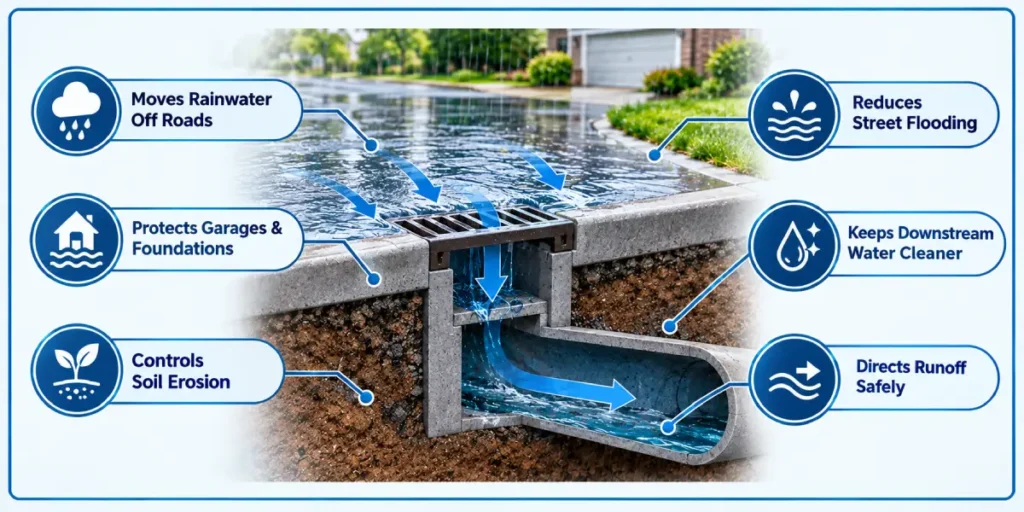
Take the drain away and even a plain afternoon rain turns roads into shallow ponds and pushes water up against foundations.
There is a second job as well. Fast water chews at loose soil and hauls it into streams, so by catching the runoff and letting it out slowly, the drain keeps erosion down and the water downstream a good deal clearer.
How a Storm Drainage System Works
A storm drain system is not one pipe. It is a string of parts, each one handing water to the next, and gravity does most of the pushing. Water drops in at the surface, settles into a chamber, runs through pipes underground, then spills out somewhere near a creek or the sea. Easier to take it one piece at a time.
What Is a Storm Drain Inlet?
A storm drain inlet is the mouth of the whole thing, the part you can see from the street. Some are cut sideways into the curb. Others lie flat in the road as a metal grate. Either way, the grid on top lets water through and holds the bigger junk back.
Catch Basins
Right under the inlet sits the catch basin. Picture a concrete box with a low well at the bottom. Heavy stuff, grit, wet leaves, the odd bottle cap, drops into that well instead of carrying on down the line. It works until it fills. A packed catch basin catches nothing, which is why crews scoop them out on a schedule.
The Pipes and Where the Water Ends Up
Past the catch basin, the water enters the storm drain pipe. Close to a single inlet, it might be a foot wide. Follow it downstream, though, to where plenty of lines meet, and a stormwater drain pipe can be tall enough to stand up inside. The shape of any stormwater drainage system comes down to local rainfall, the slope of the land, and how much of the ground got paved over. Crews size the storm drain piping for a hard storm, then aim it at an outfall, the open mouth that empties into a creek, a river, or the ocean. Most stormwater drainage systems across the US run this same way: untreated water, sent straight to the nearest waterway.
Storm Drain vs Sewer: What Is the Difference?
People swap these two words around all the time. Look up sewer vs storm drain, and the whole thing lands on one question: does the water get cleaned before it leaves? A storm drain, no. A sanitary sewer, yes. That one gap explains the rest of it.
| Feature | Storm Drain (Storm Sewer) | Sanitary Sewer |
|---|---|---|
| What it carries | Rain and surface runoff | Wastewater from sinks, toilets, and showers |
| Treatment | None; let out untreated | Sent to a treatment plant first |
| Where it ends up | Local creeks, rivers, the ocean | A treatment facility, then discharged |
| Typical entry point | Curb inlets and street grates | Indoor drains and household plumbing |
(Setups differ from town to town, so your local one might not line up with this exactly. Older places sometimes still run a combined system, which comes up next.)
So the storm drain vs sewer drain mix-up is really two separate pipe networks sharing the same streets. A storm sewer pipe carries runoff and nothing else, untreated. A sanitary sewer pipe carries waste and ships it off to be cleaned.
Old cities muddy the picture. Their combined sewer stuffs both into one pipe, which holds up fine right until a big storm floods it and forces a mix of sewage and runoff out into the open. The EPA has spent years helping towns move off that old design.
Storm Drain vs Catch Basin
Here people expect a fight. There isn’t one. It sounds like two things squaring off, but the catch basin sits inside the storm drain. Asking catch basin vs. storm drain is close to asking whether you would rather have an engine or a car.
The storm drain is the whole run, inlet to outfall. The catch basin is just the trap near the top, the piece that grabs sediment and grime before any of it reaches the pipes. Say the catch basin is blocked, and you mean the well is choked with sludge. Say the storm drain is blocked, and the clog could be sitting anywhere down the line.
What Is a Storm Drain Easement?
Own property? Read this part twice. A storm drain easement is a legal right, granted to a city or a utility, to step onto a slice of your land and put in drainage or keep it working. It gets recorded against the property, and it stays put even after you sell the house.
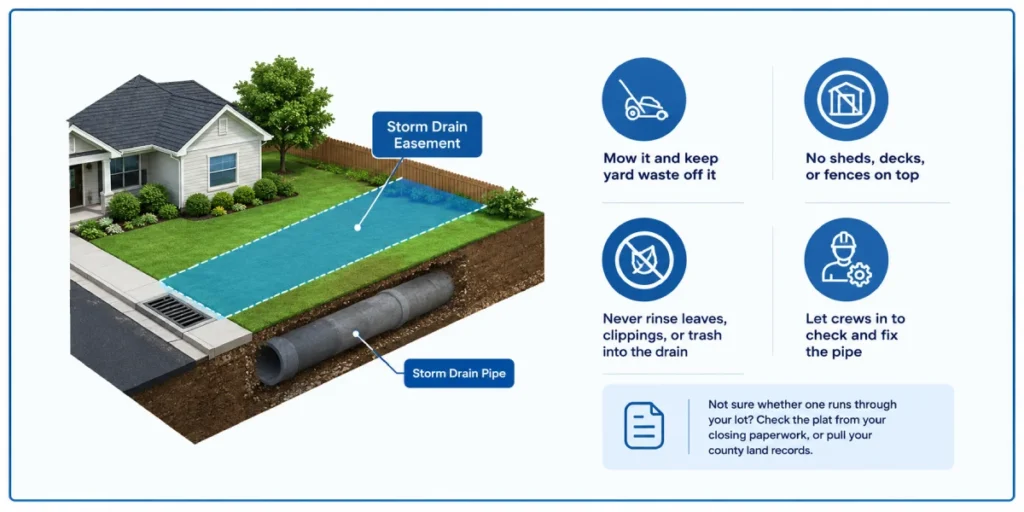
You still own that strip of ground. What you give up is the freedom to build on it or wall it off. Public works departments like Fairfax County spell it out plainly: no permanent structures over the easement. Day to day, the load that falls on you tends to look like this:
- Mow it and keep yard waste off it
- No sheds, decks, or fences on top
- Never rinse leaves, clippings, or trash into the drain
- Let crews in to check and fix the pipe
Not sure whether one runs through your lot? Check the plat from your closing paperwork, or pull your county land records.
Storm Drain Questions, Answered
Not sure what that grate at the curb actually does? These FAQs break down the essential parts of a storm drain system, from grates and catch basins to underground pipes and outlets, so you know what happens to runoff when the next big storm hits.
What is a storm drain cover called?
Grate, usually. Or storm drain grate, if you want the long version. People mix it up with a manhole cover, but that is the round solid lid over an access shaft, a separate piece entirely. So the grid filling with leaves at your curb? That is the grate.
What is a storm drain catch basin?
Look under the inlet grate, and you’ll find a boxed concrete chamber. At its base sits a well, and that well holds sediment, grit, and trash back before any of it slides into the pipe. Clean it on a schedule. Skip that, and it stops holding anything.
What is a storm drain system?
Everything that moves runoff from the street to the outlet. Inlets at the surface, catch basins catching debris, pipes buried underneath, and an outfall where the water finally leaves. Gravity does the work. None of it connects to the wastewater plumbing in your house.
Can you pour anything down a storm drain?
Rainwater and nothing else. That water reaches creeks and the ocean untreated, so oil, paint, or leftover cleaner tipped into a storm drain lands in the environment exactly as it left your hand. In plenty of places, it’s also illegal. The EPA ranks this kind of runoff among the biggest sources of water pollution.
Final Thoughts
Once you know ‘what is a storm drain,’ that plain metal grate on your street stops being background. It stands between a hard rain and your road, your foundation, and the creek downstream. Only while it’s clear, though. Let an inlet pack with leaves or a catch basin fill with silt, and the water backs up onto the pavement, then into the driveway, and a routine storm turns into a mess.
Slow drain on your Ventura County property? Backing up, or full of debris? Drain Pros Ventura cleans, inspects, and repairs storm drains and drainage lines throughout Ventura County, the San Fernando Valley, and Santa Clarita. Cheaper to check it now than to dry the place out in February.