
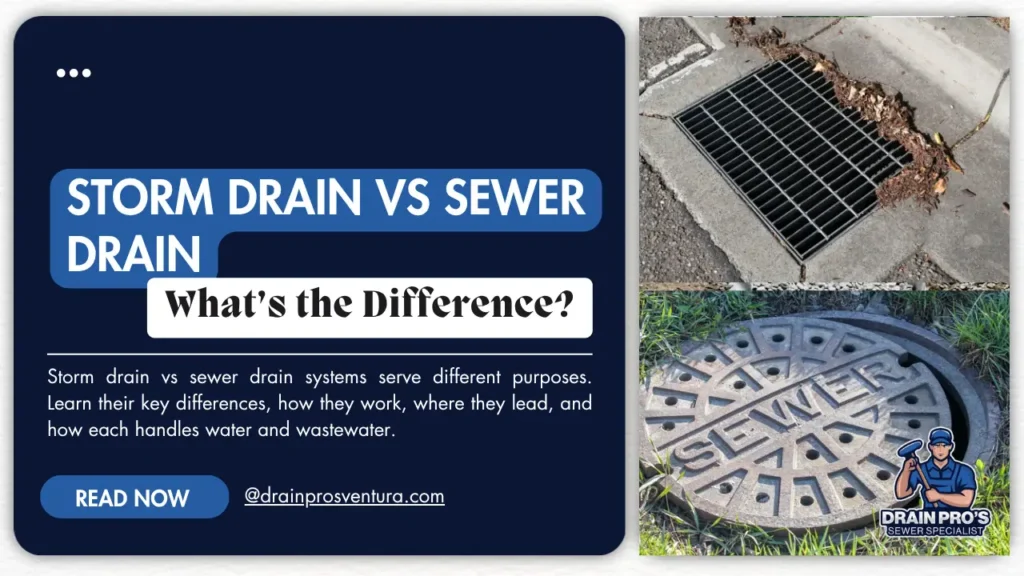
When heavy rain leaves water pooling around your property, it’s easy to assume the worst without knowing what’s actually going on underground. Is it a storm drain problem, or something with the sewer line? The two get confused a lot, but they’re doing completely different jobs.
Storm drains handle rainwater and runoff; the water coming off your driveway, the street, parking lots, anywhere rain hits pavement. Sewer drains are a different animal entirely. They carry wastewater away from your toilets, sinks, showers, and washing machines, sending it off to a treatment plant or, if you’re on one, a private septic system.
Once you know which is which, spotting the source of a problem gets a lot easier. You’ll know where that water is actually headed, and more importantly, which system you need someone to look at when things go sideways.
Storm Drain vs Sewer Drain at a Glance
Here’s the easiest way to tell them apart, what each one carries, where you’ll find it, and where the water actually ends up.
| Feature | Storm Drain | Sanitary Sewer |
|---|---|---|
| Primary purpose | Collects rain and runoff | Carries wastewater away from buildings |
| What it carries | Rain, snowmelt, and runoff off the ground | Water from toilets, sinks, showers, washing machines, and other fixtures |
| Main system | Stormwater drainage system, or storm sewer | Sanitary sewer system |
| Typical locations | Streets, curbs, parking lots, yards, low spots | Homes, businesses, bathrooms, kitchens, underground sewer lines |
| Where it leads | Waterways, detention ponds, infiltration systems, or similar infrastructure | Wastewater treatment plants or private septic systems |
| Water treatment | Sometimes gets limited treatment, depending on the local setup | Almost always treated before it’s discharged or reused |
| Main function | Keeps rainfall from flooding the surface | Moves wastewater off to get treated |
| Common terms | Storm drain, storm drain inlet, storm sewer | Sanitary sewer, sewer line, sewer drain |
The key distinction is simple: storm drains deal with water from outside your home, sewer drains deal with water that’s already been used inside it.
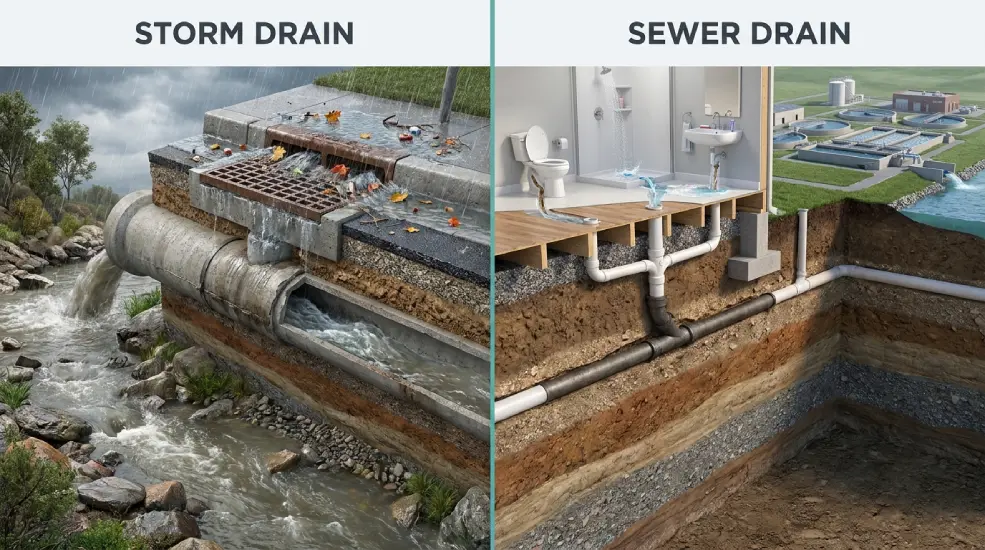
What Is a Storm Drain?
A storm drain is basically an inlet or opening built to collect rainwater and surface runoff. You’ve almost certainly seen these: the metal grates along roads, at the edge of parking lots, or tucked into low spots where water tends to pool after a storm.
That visible grate is the storm drain inlet. Underneath it, water drops into a catch basin or underground pipe system that carries the runoff away from the surface and out of sight.
Depending on how the system’s designed, stormwater drainage networks cut down on standing water and flooding by routing runoff into underground pipes, drainage channels, detention facilities, infiltration systems, or nearby waterways.
How Do Storm Drains Work?
It starts when rain hits surfaces like roofs, roads, driveways, and parking lots.
Say rain lands on a roof, it’ll typically run through the gutters and downspouts before it ever touches the ground. From there, it moves across whatever surface it’s on and follows the natural slope until it reaches a storm drain inlet.
Here’s roughly how that plays out:
- Rain falls on roofs, roads, driveways, and other surfaces.
- Runoff makes its way toward a low point or storm drain inlet.
- Water enters through the grate.
- A catch basin catches sediment, leaves, and other heavier debris along the way.
- Water flows into underground stormwater pipes.
- The drainage network carries it off toward wherever it’s ultimately headed, a discharge point or storage facility.
Most stormwater systems just rely on gravity to do the work, though some areas use pumps when the natural slope isn’t enough to move water on its own.
Where Do Storm Drains Go?
Where the water ends up really comes down to the local drainage setup.
Stormwater might flow through underground pipes to:
- Streams and rivers
- Lakes or coastal waters
- Detention or retention ponds
- Drainage channels
- Infiltration systems
- Wetlands
- Other stormwater management facilities
Unlike sanitary wastewater, stormwater usually doesn’t get treated to the same degree. That said, some systems do include sediment traps, filters, oil separators, or other treatment features before the water gets discharged.
One thing worth keeping in mind: stormwater picks up whatever it flows over, oil, debris, chemicals, you name it. So never pour paint, oil, or anything harmful down a storm drain. It’s not going to a treatment plant first.
What Is a Sanitary Sewer/Sewer Drain?
Ever wonder where the water actually goes after you flush? That’s the sanitary sewer’s job. It’s an underground network that collects wastewater from houses, businesses, wherever, and hauls it off somewhere it can be dealt with properly.
Where’s this water coming from exactly? Mostly:
- Toilets
- Sinks
- Showers and baths
- Washing machines
- Dishwashers
- Pretty much any plumbing fixture in the building
We’re talking human waste, soap residue, detergent, grease, bits of food, bacteria. A real mix. Definitely not something you’d want dumped just anywhere, which is why it gets routed to treatment instead of, say, a nearby creek.
Here’s a detail most people miss. In newer neighborhoods, the sanitary sewer and the stormwater drains are two separate systems entirely, running on their own pipes. Older parts of a city, though? Sometimes they still have combined sewers, where rainwater and sewage flow through the exact same pipe. It’s an old design choice, not really used anymore for new construction, but plenty of it is still out there underground.
How Does a Sanitary Sewer Work?
The whole thing kicks off inside your own walls.
Flush a toilet. Run the sink. Take a shower. Do a load of laundry. All that water heads into the internal drainpipes, then out to what’s called the building sewer, or private sewer connection if you want to get technical, before it ever touches the public system.
Roughly, the path looks like this:
- Water leaves the fixture, wherever it started.
- It travels through the internal drainpipes.
- Reaches the property’s own sewer connection.
- Joins up with the larger public sanitary sewer line.
- Gets pushed along, either by gravity or a pumping station if the terrain calls for it.
- Arrives at a treatment facility.
- Passes through several stages of treatment before it’s discharged or reused.
Basically, treatment is there to strip out the solids, the organic matter, the pathogens, all of it, so whatever comes out the other end actually meets health and environmental standards.
Storm Sewer vs Storm Drain
The terms storm drain and storm sewer are sometimes used interchangeably, but they can describe different parts of the same drainage system.
A storm drain or storm drain inlet generally refers to the visible opening where rainwater enters the drainage system. A storm sewer usually refers to the underground pipes and network that transport stormwater.
For example, the grate you see along a road may be the storm drain inlet, while the underground pipe connected to it forms part of the storm sewer system.
The exact terminology can vary between municipalities, so local authorities may use these terms differently.
Learn more about the difference between a storm drain and catch basin and how each system helps manage stormwater.
Storm Drain vs Sewer Drain: What Actually Sets Them Apart
Couple things separate these two, and once you know them, telling one from the other gets pretty easy.
What They’re Actually Carrying
This is probably the main thing to know.
Storm drains? Rainwater and runoff, basically. It rolls across streets, driveways, parking lots, picking up whatever’s out there. Oil stains, road salt, dirt, leaves, you name it.
Sanitary sewers are a totally different story. That’s wastewater coming straight out of people’s homes and businesses, sewage, detergent, grease, bacteria, the whole deal.
Where You’ll Actually Find Them
Storm drains sit out in the open, mostly. Look for them around:
- Streets
- Kerbs
- Driveways
- Car parks
- Yards
- Commercial properties
- Low-lying spots
Sewer connections aren’t so obvious. Everything starts with the plumbing inside your walls and disappears underground pretty quick after that.
There’s one exception worth mentioning: the sewer cleanout. It’s that small cap you might’ve noticed in the yard somewhere, gives a plumber access to the line without tearing anything up.
Where the Water Actually Goes
After it leaves your property, these two go completely separate ways.
Stormwater typically ends up in a creek, a detention pond, an infiltration system, basically whatever the local infrastructure is set up to handle.
Wastewater heads to a treatment plant instead, or if you’re on a private system like a septic tank, wherever that setup sends it.
Does Anyone Actually Treat It?
Not the same way, no. Stormwater mostly bypasses real treatment, though some setups throw in filtration or sediment traps to catch the worst of it before release.
Wastewater? That gets treated pretty much every time before it’s discharged or reused.
And that’s kind of the whole point here. Stormwater can hit a nearby stream in minutes with barely anything done to clean it up first. Wastewater doesn’t get off that easy, it runs through an actual treatment process before anyone lets it back into the environment.
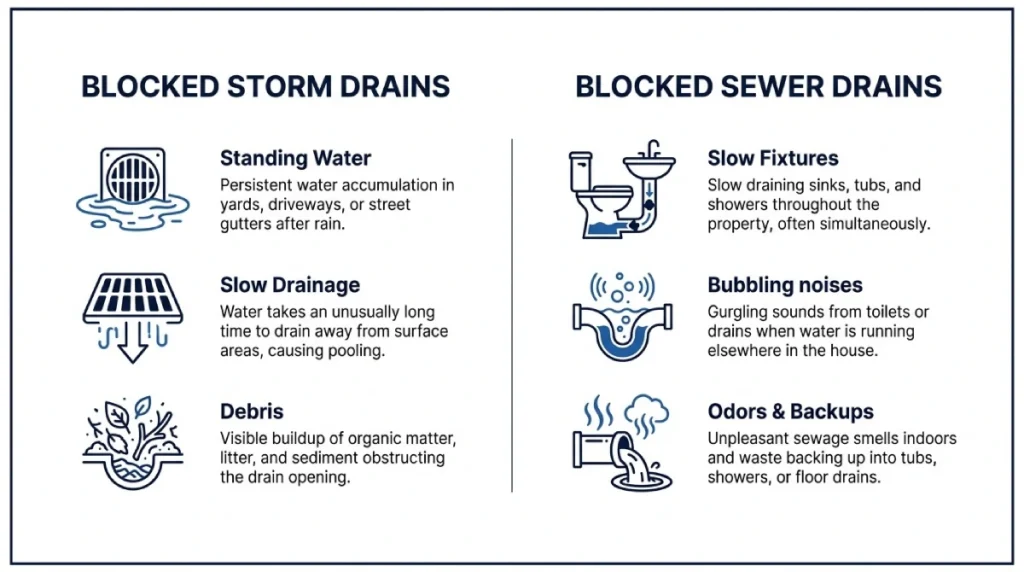
What Happens When a Drain Gets Blocked?
Here’s the thing about a clogged sanitary sewer: wastewater doesn’t just disappear like it’s supposed to. It slows down, sometimes it backs up right into your house. And unlike a rainwater problem, this one smells bad and can actually be a health issue.
Signs of a Blocked Sewer Drain
A few things to watch for:
- Sinks, tub, and toilet all draining slow, at the same time
- Toilet backing up, maybe even overflowing
- Gurgling noises down in the pipes
- That sewage smell, inside the house or right around the foundation
- Water showing up in the shower or tub when it shouldn’t be
- Wastewater pooling near the exterior cleanout
- Washing machine running and somehow another fixture fills with water
Notice more than one fixture acting up at once? That usually points past the individual drain, further down toward the main line.
Best bet at that point is getting someone out there to actually find where the blockage is.
Can Rainwater Get Into a Sanitary Sewer?
In theory, no. Most communities keep these systems separate on purpose. In practice, rain sneaks in anyway, through what’s known as inflow and infiltration.
- Inflow is rainwater getting in directly, a downspout hooked up wrong, a cracked cleanout, some opening that shouldn’t be letting water through.
- Infiltration is a slower creep, groundwater working its way in through cracks, bad joints, connections that have worn out over time.
Add enough of both together and you’re pushing more water through a system than it was ever built for. Heavy rain plus that extra load? That’s when sewers start hitting capacity problems, and sometimes that means backups.
There’s also older parts of some cities still running combined systems, where stormwater and sewage just share a pipe. Nobody builds them that way anymore, but plenty are still buried out there.
What Happens During a Big Storm?
A lot of water, fast. Roughly, this is the order things happen in:
- Rain hits roofs, roads, driveways, whatever surface it lands on.
- It runs toward the nearest storm drain or drainage point.
- That water enters the stormwater network.
- Pipes underground carry it away from the developed area.
- From there it gets stored, soaked into the ground, treated, or released, depending on what the local system’s set up to do.
Sometimes rain just comes down faster than any system can move it, and water pools up even when nothing’s actually broken. Throw in a blocked inlet or a damaged pipe on top of that, and flooding gets worse fast.
Which System Is Actually on Your Property?
Truth is, most properties have both, one handling indoor wastewater, one handling outdoor rain. What you’ve got exactly depends on your location and how old the place is.
Look outside for stormwater features, things like:
- Roadside grates
- Yard drains
- Driveway drains
- Car park inlets
- Catch basins
Sanitary sewer stuff tends to be:
- Interior plumbing drains
- Exterior sewer cleanouts
- Private sewer connections
- Underground sewer lines
Sometimes you just can’t tell by looking though. When that happens, pull your property’s drainage plans or call up the local water or public works department.
What Do You Actually Do About It?
Depends which system’s acting up.
Storm drain blocked? First check for leaves, trash, whatever’s piled on the inlet. Don’t go pulling off heavy covers or climbing into a catch basin on your own. Still flooding, or can’t clear it yourself? Time to call the property manager or a drainage professional.
Sanitary sewer instead? Stop running toilets, the washer, showers, anything, until it’s been looked at. Every bit of extra wastewater just makes a backup worse.
An inspection will sort out whether it’s a simple clog, a cracked pipe, roots growing into the line, grease buildup, or something else going on.
Final Thoughts
Once you understand storm drains versus sewer drains, the way water moves around your property just makes more sense.
Storm drains and storm sewers deal with rain and runoff. Sanitary sewers collect wastewater from your home or business and send it off to get treated. Normally they run completely separate, but things like damaged pipes, bad connections, or inflow and infiltration can blur that line.
Know the warning signs for both, and you’ll catch a small problem before it turns into a much bigger, messier one.
Frequently Asked Questions
Does a storm drain actually collect stormwater?
Yes, that’s basically its whole job. It picks up rainwater and runoff from streets, driveways, parking lots, yards, wherever water’s flowing outside, and sends it into the stormwater network or whatever local drainage setup handles it.
Does a storm drain ever connect to the sewer?
Depends where you live. Most modern places keep the two completely separate, storm drains and sanitary sewers run through their own pipes. But some older towns still have combined systems where both share the same line. It’s an older way of building things, not really done anymore.
Where does all that stormwater runoff actually end up?
Could be a lot of places, honestly. Streams, rivers, lakes, coastal water, a detention or retention pond, an infiltration system, really just depends on what infrastructure your area’s got set up.
Does stormwater go to a treatment plant?
Usually not, at least not if you’re on a separate system. It follows its own dedicated network instead. The exception’s those older combined sewer systems, where stormwater and wastewater do end up traveling the same pipe.
Is a sewer line the same thing as a sewer drain?
Not quite, though people mix them up constantly. The sewer line’s the actual pipe moving the wastewater along. A drain’s more the opening or fixture where water first enters that pipe. Day to day though, most people just say “sewer drain” for anything connected to the sanitary sewer.
Can stormwater sneak into a sanitary sewer?
It can, yeah, even though it’s not supposed to in a properly separated system. Rain gets in through damaged pipes, bad connections, downspouts hooked up wrong, cracked or missing cleanout caps, stuff like that. There’s actually a name for it, inflow and infiltration, and it can push more water through the sewer system than it’s meant to handle.
How do I know if it’s a storm drain problem or a sewer problem?
If it’s outdoor flooding during rain, that’s almost always the stormwater system acting up. If it’s your toilets, sinks, or shower draining slow or backing up, that’s pointing to the sanitary sewer instead. Still can’t tell? Get someone out there to actually look, they’ll know pretty quick which system’s causing the trouble.
How do I know if it’s a storm drain problem or a sewer problem?
If it’s outdoor flooding during rain, that’s almost always the stormwater system acting up. If it’s your toilets, sinks, or shower draining slow or backing up, that’s pointing to the sanitary sewer instead. Still can’t tell? Get someone out there to actually look, they’ll know pretty quick which system’s causing the trouble.