
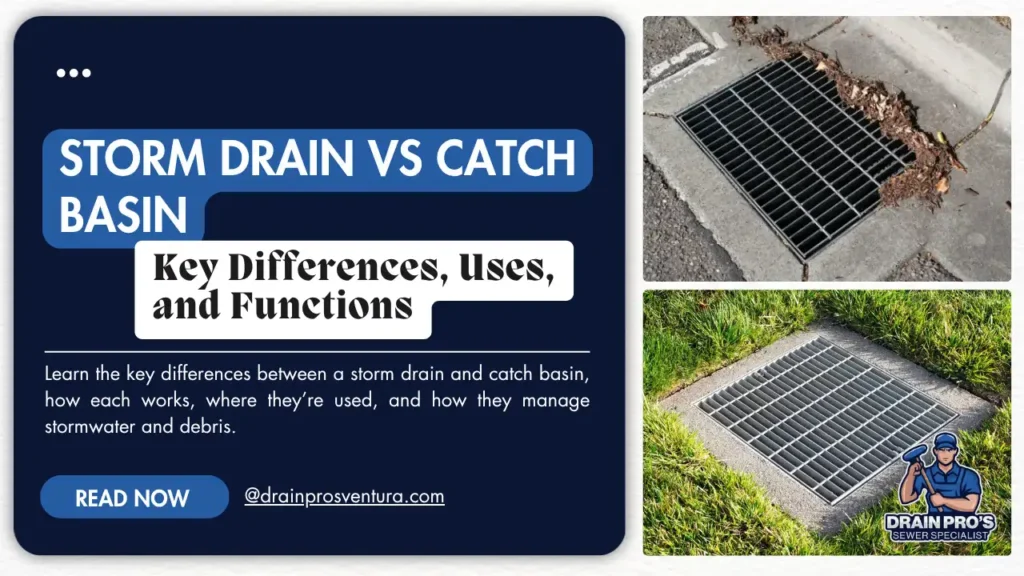
Ever wondered why heavy rain doesn’t puddle in the street for hours? The answer usually comes down to two systems people often confuse: storm drains and catch basins. A catch basin traps sediment and debris before water enters the sewer system. A storm drain acts as a path that carries stormwater runoff away. Together, they prevent flooding in residential and commercial areas and keep the underground pipe network from getting clogged.
Storm Drain vs Catch Basin Summary
| Feature | Storm Drain | Catch Basin |
|---|---|---|
| Primary purpose | Collects and carries stormwater away from paved or low-lying areas | Collects surface water while capturing sediment and debris |
| Main structure | Usually an inlet, grate, or opening connected to drainage pipes | Underground box or chamber with a grated opening and sump |
| How it works | Directs runoff into a stormwater drainage network | Collects runoff, allows heavier debris to settle, then sends water through an outlet pipe |
| Debris collection | Limited, depending on the inlet design | Designed to collect sediment, leaves, and other debris |
| Common locations | Streets, curbs, parking lots, and large paved areas | Yards, driveways, landscaped areas, and parking areas |
| Maintenance | Inspect grates, inlets, and connected drainage lines | Regularly remove accumulated sediment and debris |
| Best suited for | Moving stormwater efficiently through a drainage system | Collecting runoff and reducing debris entering drainage pipes |
What Is a Catch Basin?
A catch basin is a masonry or plastic box set into the ground with a grate on top to catch surface water. The catch basin drain refers to the complete underground unit sitting beneath the grate you see in a yard or driveway.
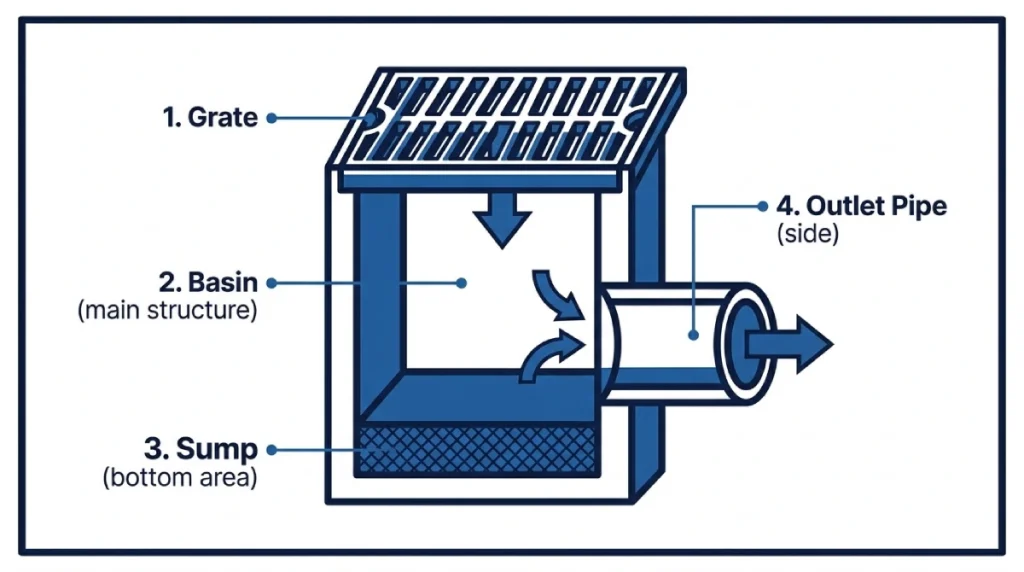
The basic components of a catch basin include:
- Grate: The metal or plastic cover that lets water in while keeping large objects out.
- Basin: The main structure, or “box,” that holds the water.
- Sump: The area at the very bottom, below the outlet pipe, where sediment settles.
- Outlet Pipe: The pipe located higher up the side of the basin that carries water to the main line.
Catch basins separate sediment and debris from water using gravity alone, with no moving parts.
How Does a Catch Basin Work?
The process is simple but effective:
- Rainfall or irrigation runoff flows across the ground toward the grate.
- Water enters the basin through the openings.
- Once inside, the water level rises while heavier sediment and debris settle into the sump at the bottom.
- As the water level reaches the height of the outlet pipe, the cleaner water on top exits through it.
- The connected drainage system carries that water away to a discharge point.
Catch Basin Applications
Catch basins are versatile tools for water management. A catch basin for yard drainage is common in low-lying areas of a lawn where puddles form. In driveways and parking areas, they prevent sheets of water from creating hydroplaning hazards. They’re also used in landscaped areas to keep mulch from washing away.
What Is a Storm Drain?
A storm drain is a system of openings and pipes used to remove excess surface water from roads, lots, and other paved areas. It has two parts: the storm drain inlet, which is the visible structure on the street, and the larger stormwater drainage network of underground piping it connects to.
Unlike a catch basin, a storm drain doesn’t always have a sump to trap debris. Its main job is moving a large volume of water fast. You’ll find storm drains along roads, curbs, and in large commercial parking lots, where water needs to move immediately to prevent traffic hazards.
What Does a Storm Drain Look Like?
The appearance of a storm drain varies by location. A curb inlet is a horizontal opening cut into the side of a concrete curb. A grated inlet looks like a heavy metal grid set into the asphalt. A combination inlet uses both a curb opening and a grate to handle large amounts of water during flash floods.
Types of Storm Drains
- Curb Inlets: Found on city streets to catch water flowing along the gutter.
- Grated Inlets: Standard metal grates found in parking lots or flat paved areas.
- Combination Inlets: A mix of the two above for high-capacity areas.
- Area Drains: Smaller versions often used on residential patios or walkways.
How Does Stormwater Move Through a Catch Basin and Storm Drain?
Rain falls and runs across the ground as surface runoff, flowing toward a catch basin or storm drain inlet. If it enters a catch basin, sediment settles into the sump while the water rises and flows out through the outlet pipe into the larger stormwater system. From there, the water eventually reaches a discharge point, such as a stream, river, or retention pond.
Where Does Storm Drain Water Go?
Stormwater moves through the drainage system and empties directly into local waterways, such as streams, rivers, or detention and retention ponds designed to slow the water down before it reaches a natural water body. Unlike the water that goes down your sink or toilet, storm drain water isn’t treated at a treatment plant, which is why it matters what ends up washing into one.
Catch Basin vs Storm Drain: How They Work Together
A catch basin acts as the collection and sediment-settling point in a well-designed drainage system, while the connected pipe network is the route the water travels. This makes the catch basin the entry point for a larger, city-wide storm drain system. Together, they keep the whole system running: the catch basin keeps dirt out of the storm drain pipes and prevents the network from clogging.
Storm Drain vs Catch Basin: Comparing Drainage Solutions
Both storm drains and catch basins play essential roles in managing stormwater, but they differ in function, design, and where they’re used.
Function and Purpose
A catch basin is designed for water quality and pipe protection by trapping solids. A storm drain is designed for water quantity and flood prevention by moving water as fast as possible.
Design and Construction
Catch basins have a “dead zone,” or sump, at the bottom to hold sediment. Storm drains are often built so the bottom of the structure is flush with the outgoing pipe, letting everything flow straight through.
Water and Debris Handling
Catch basins proactively stop debris from moving further into the system. Storm drains rely on the force of the water itself to push debris through to the final exit point.
Typical Location
You’ll find catch basins in residential yards and near landscaping. Storm drains show up more often on public roads and large industrial sites.
Maintenance Requirements
Catch basins need manual cleaning, either by hand or with a vacuum truck, to remove sediment on a regular schedule, since that sediment is exactly what they’re designed to trap. Storm drains generally need less routine maintenance day to day, but they need prompt attention if a major storm causes a blockage in the connected pipe network.
Residential vs. Commercial Applications
Residential systems tend to rely on catch basins to keep small-diameter pipes from fouling. Commercial properties rely on larger storm drains, which can handle the tremendous volume of water flowing off acres of pavement.
What Is a Drainage Basin?
The term “drainage basin” is often confused with a catch basin, but they’re very different things. A drainage basin refers to a broad geographic area, often called a watershed, that funnels water toward a river.
- Drainage Basin: A massive area of land, like a valley, that funnels water to a river.
- Catch Basin: A physical box in the ground that catches water.
- Storm Drain: The inlet or pipe that moves the water.
- Stormwater Drainage System: The entire man-made network of basins and pipes.
When Do You Need a Catch Basin for Drainage?
Both catch basins and storm drains are essential, and depending on your situation, you may need one or both.
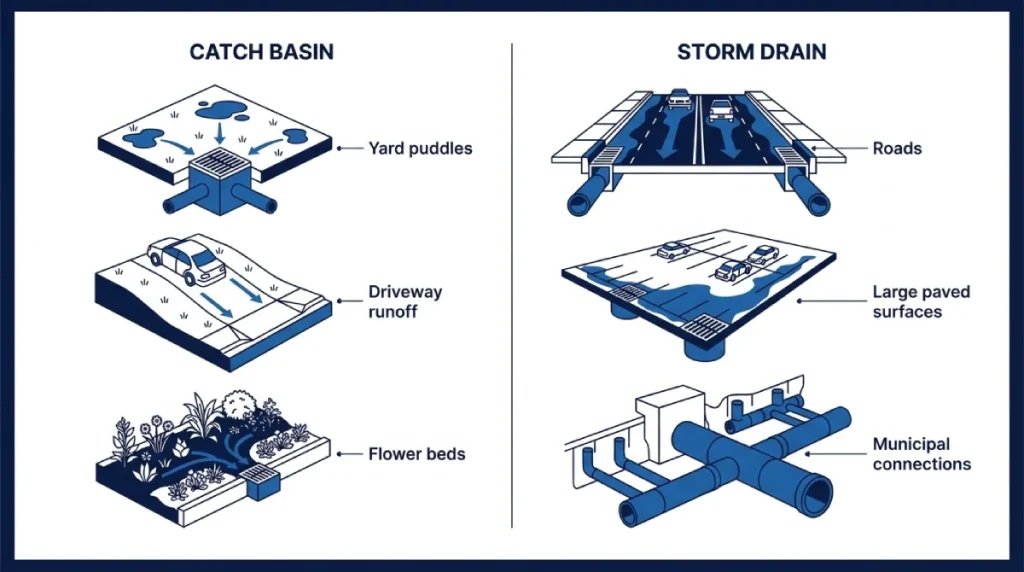
When a Catch Basin Makes Sense
Consider installing a catch basin when you have low areas in your yard that stay wet for days or collect puddles after rain. Catch basins are also useful for managing runoff from driveways or downspouts that concentrate a lot of water in one spot.
When a Storm Drain May Be More Appropriate
For roads or large paved surfaces where deep puddles tend to form, a storm drain is the better option. Heavily used commercial properties also rely on storm drains, since they connect to larger municipal stormwater systems built to carry high-velocity flows.
When You May Need Both
In a simple home setup, you might place a catch basin in a flower bed to collect silt, then run a storm drain pipe from there to direct the water to the street. Commercial parking lots often use catch basins for the same reason, to keep sediment from clogging the storm drain line downstream.
Frequently Asked Questions About Storm Drains and Catch Basins
Is a catch basin the same as a storm drain?
No. A catch basin is a special kind of inlet with a sump that traps debris. A storm drain is a system that carries rainwater runoff away from an area.
Is it possible for a catch basin to connect with a storm drain?
Yes. Most catch basins serve as the entry point that connects to a larger storm drain pipe network.
How does a catch basin work?
Water flows into the basin, where heavier debris sinks to the bottom. As the water level rises, it drains out through an outlet pipe set higher up the side of the box, leaving the sediment behind.
Where does storm drain water go?
Stormwater drains to a local river, lake, or pond. It usually isn’t treated at a sewage plant, so never pour chemicals down one of these drains.
Where do you see storm drains?
You’ll typically spot a metal grate set into the ground or a rectangular cutout in a concrete street curb.
What’s the difference between a drainage basin and a catch basin?
A drainage basin is a large area of land, or watershed, while a catch basin is a small, man-made box for local drainage.
Does a catch basin help yard drainage?
Yes, it’s one of the best ways to remove standing water in low areas of a lawn.
When does a catch basin need to be cleaned?
Check it once a year, and clean it out when sediment in the sump builds up to within 6 inches of the outlet pipe.
What happens if a catch basin becomes clogged?
Water backs up and floods the surface around the grate. If the clog reaches the outlet pipe itself, you may need a professional to hydro-jet it clear.
Final Thoughts
A catch basin’s main job is removing sediment from runoff to protect the plumbing downstream. A storm drain’s job is to move stormwater quickly to keep streets and property from flooding. The right drainage system for your property depends on your drainage needs, site layout, and expected runoff.