

What Is Pipe Descaling and Why Does It Cost What It Costs
Pipe descaling is a professional plumbing process that removes scale, rust, mineral buildup, and hardened organic matter from inside your drain and sewer lines without digging up your yard or tearing into your walls. The process restores pipe diameter to near-original size, eliminating flow restrictions that cause slow drains, frequent backups, and accelerated corrosion.
In Ventura County, older homes (most of those built before 1980) rely heavily on cast iron sewer lines that are now 40 to 70 years old. These pipes are particularly susceptible to interior rust scale that can reduce a 4-inch pipe down to less than 2 inches of usable diameter. That is not a minor inconvenience. It is an active drain failure waiting to happen.
A study by the Water Research Foundation found that scale buildup in aging cast iron pipes reduces effective flow capacity by 30 to 60 percent before homeowners notice any symptoms. By the time symptoms appear, the buildup is already severe. (Source: Water Research Foundation Report 4088, 2013)
The cost of descaling is not arbitrary. It reflects the equipment needed (chain knockers, water jets, descaling rotors), the labor hours required for a sealed sewer system, and the pre-and-post camera inspection that confirms the work actually cleared the obstruction. Skipping the inspection step means you cannot verify the outcome, which is why any legitimate descaling job includes camera work.
Drain Pros Ventura always runs a pre-descaling camera inspection. We will not send a chain knocker into a pipe we have not seen. Knowing the buildup type, pipe condition, and blockage location saves time and protects your pipes from unnecessary mechanical stress.
Pipe Descaling Cost Overview by Job Type
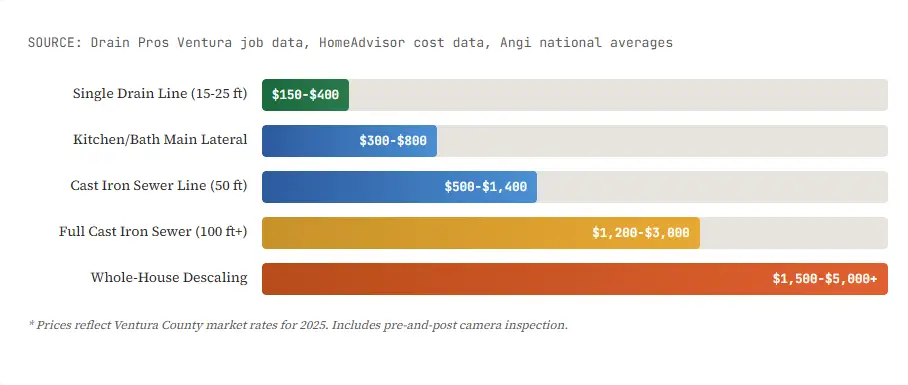
Descaling costs vary significantly based on how much pipe needs treatment, what material the pipe is made of, and the severity of the scale. Below is an honest breakdown of typical price ranges we see across Ventura County jobs.
Pipe Descaling Cost by Job Type (2025):
| Service Type | Low End | High End | Includes Camera? | Typical Duration |
|---|---|---|---|---|
| Single drain line descaling | $150 | $400 | Sometimes | 1–2 hours |
| Kitchen sewer lateral | $300 | $700 | Usually | 2–3 hours |
| Bathroom sewer lateral | $350 | $800 | Usually | 2–4 hours |
| Cast iron sewer (50 ft) | $500 | $1,500 | Yes | 3–5 hours |
| Cast iron sewer (100 ft) | $1,200 | $3,000 | Yes | 5–8 hours |
| Whole-house descaling | $1,500 | $5,000+ | Yes | 1–2 days |
| Commercial building | $2,000 | $8,000+ | Yes | 1–3 days |
Sources: HomeAdvisor pipe descaling cost data (2024), Angi national survey (2024)
Cast Iron Pipe Descaling Cost: The Full Picture
Cast iron is the most commonly descaled material and the most labor-intensive to treat. These pipes were standard in Ventura County construction from the 1920s through the 1970s. If your home was built before 1980, there is a high probability your sewer main is cast iron. Unlike PVC, cast iron corrodes from the inside out, building up rust scale that adheres to the pipe wall and compounds over years.
Why Cast Iron Descaling Costs More
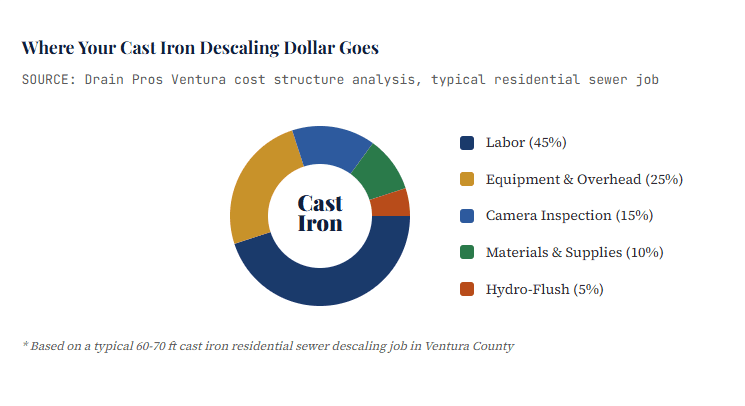
The mechanical process for cast iron requires heavier chain knocker heads, slower pass speeds, and more careful technique to avoid cracking already-fragile pipe sections. A typical cast iron sewer line job involves multiple passes with progressively larger cutting heads, followed by hydro-jetting to flush debris, and a final camera inspection. That entire sequence takes 3 to 8 hours on a 50 to 100-foot run.
| Cast Iron Pipe Scenario | Estimated Cost | Difficulty | Notes |
|---|---|---|---|
| Light scale (pipe 70–80% open) | $400–$800 | Low | Single pass, fast job |
| Moderate scale (pipe 50–70% open) | $800–$1,500 | Moderate | Multi-pass required |
| Heavy scale (pipe below 50% open) | $1,500–$2,800 | High | Multiple passes + hydro flush |
| Scale with offset joints | $2,000–$4,000 | High | Structural concern; may need lining |
| Root intrusion + scale | $1,800–$3,500 | High | Root cutting first, then descaling |
What Drives the Cost of Pipe Descaling
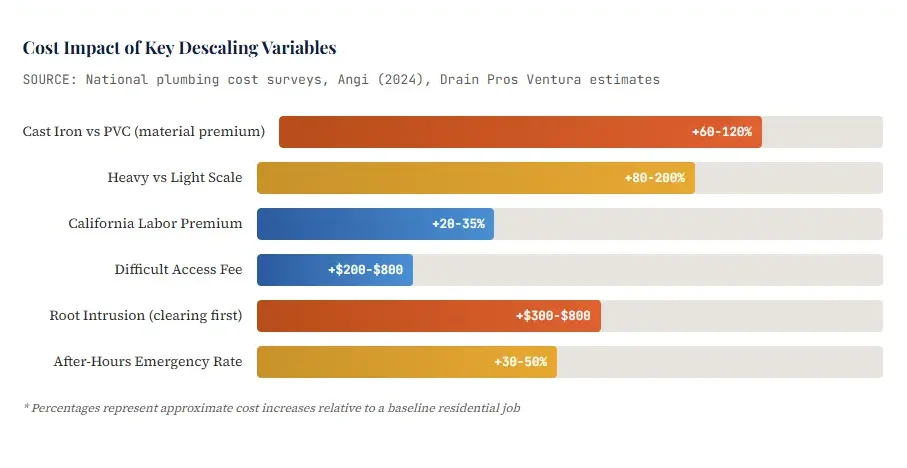
If you have called three plumbers and gotten three very different quotes, the explanation usually comes down to six variables. Understanding these lets you read quotes more clearly and ask better questions.
Pipe Material
Cast iron costs more to descale than galvanized steel, which costs more than PVC. Cast iron scale is thicker, harder, and more adhered to the pipe wall. PVC rarely needs descaling at all since mineral scale does not bond to plastic the same way.
Linear Footage
Most plumbers charge by the foot after a base rate. Expect a base call fee of $150 to $300, then $5 to $20 per linear foot depending on pipe material and scale severity. A 100-foot run costs roughly twice a 50-foot run in descaling labor.
Scale Severity
Light scale cleared in one pass costs a fraction of heavy scale that requires multiple progressive cuts with increasingly large chain knocker heads. Camera inspection before the job lets your plumber quote accurately rather than guessing.
Access Difficulty
Under-slab pipes, pipes in tight crawlspaces, or lines requiring cleanout installation before descaling can add $200 to $800 to the total cost. Access fees are legitimate, not padding. Difficult entry points take real time.
Camera Inspection
Standalone camera inspections cost $150 to $350. Most reputable descaling jobs bundle this in. If a quote does not include a pre-job camera, ask why. Descaling blind is poor practice that can miss the real problem.
Geographic Location
Labor rates in coastal California run 20 to 35 percent higher than the national average. Ventura County sits in this premium band. Jobs in Thousand Oaks, Moorpark, and Camarillo carry similar labor rates; Ventura city and Oxnard are typically comparable.
Pipe Descaling Cost by Method
There are three primary methods used for descaling residential pipes. Each has a different cost profile and a different best-use case. Understanding which method your situation requires will help you evaluate quotes and avoid being upsold on a method that is more than you need.
| Method | Cost Range | Best For | Effectiveness | Pipe Risk |
|---|---|---|---|---|
| Chain Knocker / Rotary Mechanical | $500–$2,500 | Heavy cast iron scale, thick rust | Highest | Low–Moderate |
| Hydro-Jetting (High Pressure Water) | $300–$1,200 | Light scale, grease, soft buildup | Moderate | Very Low |
| Chemical Descaling | $150–$600 | Mineral deposits in water supply lines | Moderate | Low (if correct chemical) |
| Combination (Mechanical + Hydro) | $800–$3,500 | Severe cast iron sewer scale | Highest | Low–Moderate |
Mechanical Chain Knocker Descaling
This is the standard method for heavy cast iron scale. A flexible cable drives a chain knocker head through the pipe. The rotating chains beat scale off the pipe wall as the head advances. Multiple passes with progressively larger heads restore pipe diameter in stages. This method costs more because the equipment is expensive and the process is labor-intensive, but it is the only reliable solution for thick iron scale that hydro-jetting cannot dislodge.
Hydro-Jetting for Descaling
High-pressure water jetting (typically 3,000 to 4,000 PSI for residential lines) blasts soft buildup, light scale, grease, and debris from pipe walls. It is less aggressive than mechanical descaling and will not crack fragile cast iron sections. For pipes with light to moderate scale, hydro-jetting alone may be sufficient. It is also the preferred follow-up step after chain knocker work to flush loosened scale debris. At Drain Pros Ventura, we typically combine both methods on heavy cast iron sewer jobs.
What the camera tells us before we start: If the scale is light and the pipe wall is structurally solid, hydro-jetting alone saves you money. If scale has reduced the pipe below 60 percent of original diameter, mechanical descaling is required. There is no responsible way to make that call without seeing inside the pipe first. This is why we do not skip the inspection.
Descaling vs. Full Replacement: A Real Cost Comparison
The most important financial decision in a cast iron sewer situation is whether descaling makes sense at all or whether the pipe has deteriorated too far and replacement is the smarter long-term spend. This is the question Drain Pros Ventura gets asked in almost every camera inspection call.
| Service Type | Cost Range | Key Benefits / Considerations |
|---|---|---|
| Pipe Descaling | $500–$3,000 | Restores flow, extends pipe life 5–15 years, non-invasive, preserves landscaping, completed in hours |
| Sewer Line Replacement | $4,000–$20,000+ | Permanent fix, often requires excavation, may disrupt yard/concrete/structure, takes 1–5 days |
When Descaling Is the Right Call
Descaling makes financial sense when the pipe structure remains intact, meaning no cracks, collapses, severe offsets, or root intrusion through the pipe wall itself. A pipe can be extremely scaled and still be structurally sound. Those pipes are ideal candidates. You restore full flow, buy 5 to 15 additional years of service life, and spend a fraction of replacement cost.
When Replacement Is the Right Call
If the camera reveals collapsed sections, longitudinal cracks, severe joint separation, or pipe sections that have corroded through entirely, descaling cannot help. You would be cleaning the inside of a pipe that cannot carry water reliably regardless. Descaling those pipes wastes money that should go toward replacement. Any plumber who recommends descaling without first doing a camera inspection on an aging cast iron line is skipping a step that protects you financially.
Red flag to watch for: A plumber who quotes descaling on your cast iron sewer line without ever mentioning a camera inspection. Without seeing the pipe condition, there is no basis for that recommendation. At Drain Pros Ventura, every descaling recommendation follows a camera assessment. Period.
Descaling vs Replacement: What Should You Do?
If your older home has slow drains, backups, or gurgling pipes, the problem is often cast iron sewer lines getting clogged with scale or rust. The first step is a camera inspection so you can see what’s really going on inside the pipe.
If the pipe is still in good shape (no cracks, breaks, or collapsed sections), you usually don’t need to replace it. The next thing to check is how much buildup there is. If more than 40% of the pipe is blocked, it usually needs mechanical descaling plus hydro-jetting. If the buildup is light, hydro-jetting alone can often clear it.
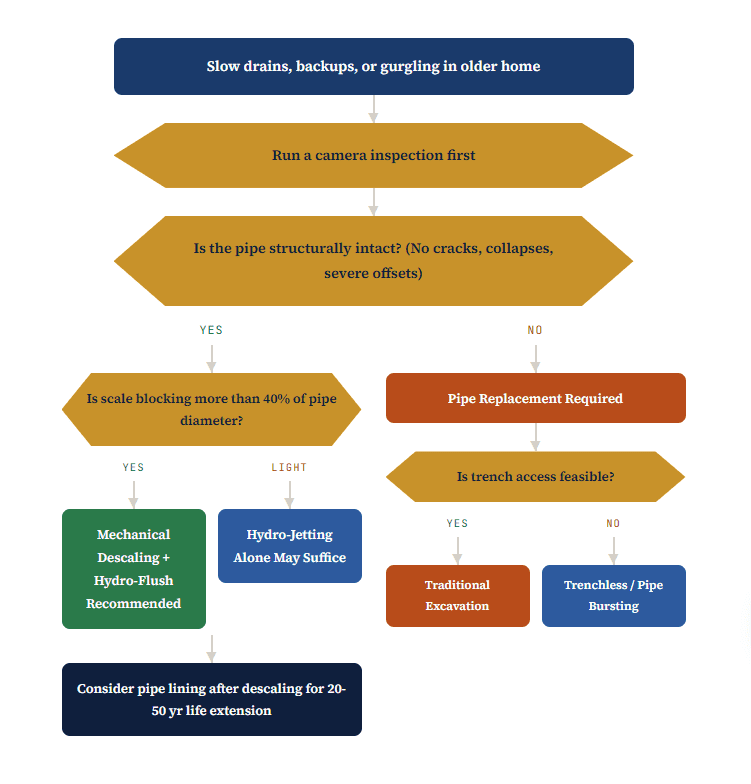
After cleaning, some homeowners choose pipe lining to help the pipes last 20–50 more years and prevent future problems.
Pipe replacement is only needed when the pipe is badly damaged. If there’s access, it can be done by digging. If not, trenchless methods may be used.
In most cases, cleaning the pipes is enough, and full replacement is only the last option.
Warning Signs Your Pipes Need Descaling Now
The symptoms of severe scale buildup are specific enough that an experienced plumber can make a preliminary assessment by phone. If you recognize more than two of these in your home, a camera inspection is warranted before the problem escalates into a complete sewer backup.
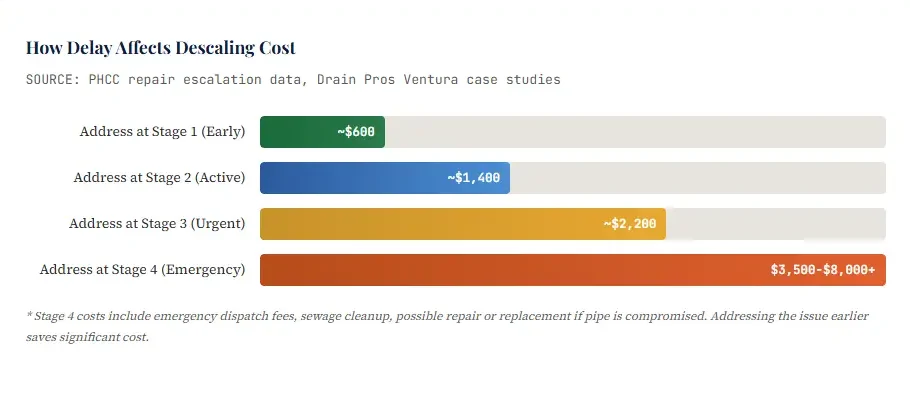
Stage 1 – Early Warning
Single drain slower than it used to be. Occasional gurgling from floor drain after heavy rain. Not urgent but worth monitoring with a camera inspection scheduled within 6 months.
Stage 2 – Active Problem
Multiple drains slow simultaneously. Gurgling in toilet after running washing machine. Light sewage odor in basement or laundry area. Schedule a camera inspection within 30 days.
Stage 3 – Urgent
Sewage backing up into tub, shower, or floor drain. Multiple fixtures affected at once. Water pooling at base of toilet. Requires immediate camera inspection and likely same-week service.
Stage 4 – Emergency
Complete sewer backup. All fixtures blocked. Sewage visible in yard. Call for emergency service immediately. This is no longer a descaling candidate until the immediate blockage is cleared.
Frequently Asked Questions
Q. How much does pipe descaling cost for a typical Ventura County home?
For a standard single-family home with cast iron sewer lines in Ventura County, expect to pay between $800 and $2,500 for a full sewer lateral descaling including pre-and-post camera inspection. Homes with shorter pipe runs or lighter scale will come in lower. Homes with 80-plus-year-old lines showing severe scale often run $2,000 to $3,500.
Q. How much does cast iron pipe descaling cost compared to PVC?
Cast iron pipe descaling costs 50 to 120 percent more than comparable PVC work because the scale bonds to cast iron, requires mechanical chain knocker equipment, and often demands multiple passes. PVC pipes rarely need descaling at all. Most descaling work is on cast iron or galvanized steel.
Q. Does descaling include a camera inspection?
It should. Any reputable descaling service includes at minimum a post-job camera verification. Drain Pros Ventura includes a pre-job camera inspection on all sewer descaling jobs because the type and severity of scale determines which method we use and what the outcome will be. If a contractor quotes descaling without mentioning a camera, ask why.
Q. How long does pipe descaling take?
A single drain line takes 1 to 2 hours. A 50-foot cast iron sewer lateral with moderate scale takes 3 to 5 hours. A full whole-house job on a large older home can take 6 to 10 hours or span two days. Emergency or access-restricted situations add time. Most residential sewer descaling jobs are completed in a single working day.
Q. How often should cast iron sewer pipes be descaled?
Most cast iron sewer lines in older homes benefit from camera inspection every 3 to 5 years and descaling every 5 to 10 years depending on usage, water hardness, and original pipe condition. If you pair descaling with pipe lining (CIPP), you likely will not need descaling again for 20 to 50 years on those sections.
Q. Is descaling worth it or should I just replace the pipe?
Descaling is worth it when the pipe structure is sound and scale is the primary problem. It costs a fraction of replacement and restores normal flow immediately. If the camera reveals structural failure, cracks, or collapse, replacement is the better investment. The camera inspection is the only way to answer this question accurately for your specific pipe.
Q. Can I descale pipes myself?
Retail chemical descalers are available but they are weak compared to professional-grade solutions and carry risk of damaging aging pipe walls if the chemistry is wrong for your pipe material. Mechanical descaling requires professional cable machine equipment. For drain lines, a consumer drain snake combined with enzyme cleaners is reasonable maintenance. For cast iron sewer lines, professional descaling is the correct approach.
Q. What is the cost of descaling sewer pipe vs. hydro-jetting?
Hydro-jetting runs $300 to $900 for residential lines. Mechanical descaling runs $500 to $3,000 depending on pipe length and scale severity. Hydro-jetting works for soft buildup, grease, and light scale. Mechanical descaling is required for the thick rust scale common in aging cast iron. Often the best approach is mechanical descaling followed by hydro-jetting to flush debris.