
Your kitchen sink was cleared three weeks ago. Now it is slow again. And the toilet makes a gurgling sound whenever the washer drains. A simple clog rarely comes back that quickly. A root clog does.
In older Ventura County homes, the sewer line is mainly clay pipe from before the 1970s, and ficus trees planted decades ago have had plenty of time to find it. The EPA counts root intrusion among the common causes of sewer overflows. The good news is that tree roots in sewer line problems leave clear signs once you know what to look for.
How Do Tree Roots Get Into Sewer Lines?
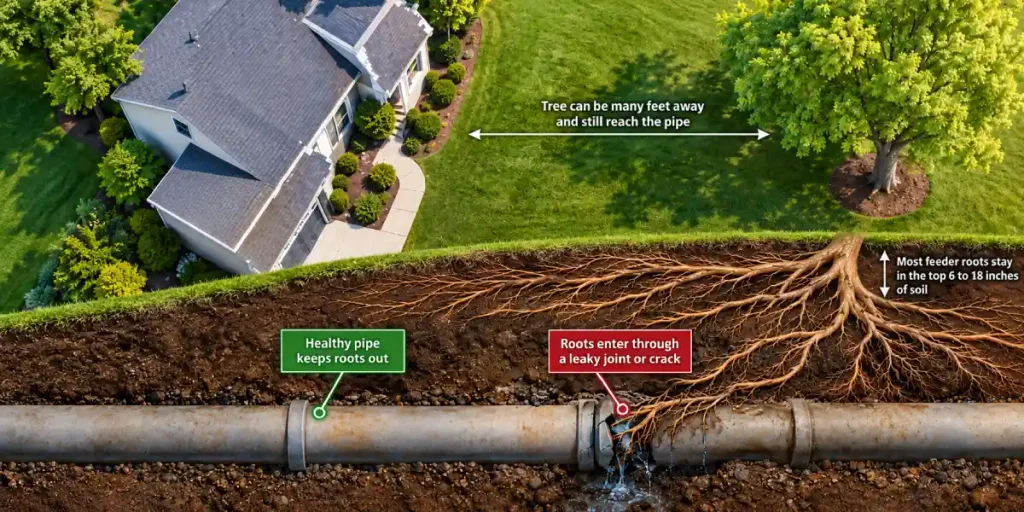
Roots cannot push their way into a pipe in good shape. They find one that is already leaking. You might expect roots to grow deep. In fact, Iowa State University Extension says the roots that soak up water mostly stay in the top 6 to 18 inches of soil. Some also spread far past the edge of the branches.
A tree across the yard can still reach your line. All it takes is one leaky joint within range.
What Roots Are Looking For
It starts small. A root tip less than a thread pushes into a hairline crack. Once inside, it keeps growing. Within a season or two, roots in pipes turn into a tangled mat. Toilet paper snags on it first, then grease.
So if you are wondering how roots get into pipes, look at the condition of the pipe before you blame the tree. A sealed line gives a root nothing to hold.
Why Older Pipes Are Most at Risk
Clay pipe comes in short sections with a joint every few feet, and decades of soil movement, the odd earthquake included, work those joints loose. Cast iron has a different weakness. Sewer gas absorbs it from the inside until the wall is thin enough to crack.
Orangeburg, a fiber pipe from the postwar years, sags out of shape. Tree roots and pipes can live side by side for years. Once one joint opens, though, the pipe damage tree roots cause gets worse each season.
Signs of Root Intrusion in a Sewer Line
One sluggish drain means little on its own. What gives root intrusion sewer line problems away is the way they spread. The trouble normally builds over several months. And it tends to show up at more than one fixture rather than a single sink.
- Backups that return a few weeks after every cleaning
- The toilet gurgling the moment the washing machine drains
- Two or three fixtures slowing together, a classic sign of roots in main sewer line trouble rather than a local snag
- One strip of lawn greener and taller than the grass on either side
- Soft ground or a shallow dip along the path of the line
- A sewer smell around a floor drain or the outdoor cleanout
If every drain in the house is slow at the same time, the problem is most likely out in the main sewer line, somewhere between the house and the street.
How to Tell If Roots Are in Your Sewer Line
Guesswork gets expensive here. A camera inspection settles the question for a fraction of what digging blind would cost. The plumber runs a waterproof camera down the cleanout and reads the pipe foot by foot.
The footage also shows the condition of the pipe, and that matters most. Skip the camera, and you may pay to clear roots in sewer pipes that are sitting in a cracked or sagging line. In that case, the roots are usually back within a year.
How to Get Rid of Roots in a Sewer Line
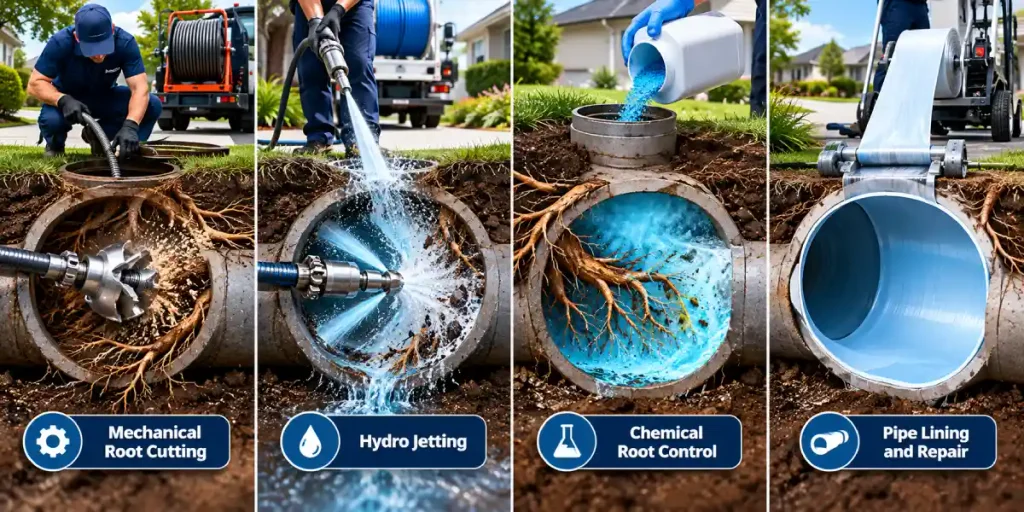
The right way to handle how to get rid of roots in sewer line blockages depends on the pipe. Most jobs start with a cutter that clears the roots. Older or badly damaged lines often need more, usually a liner or a section of new pipe.
| Method | What It Does | Best For |
|---|---|---|
| Mechanical root cutting | A spinning blade shears roots back to the pipe wall | Restoring flow quickly |
| Hydro jetting | High-pressure water scours the pipe clean | Clearing debris after cutting |
| Foaming root herbicide | Kills regrowth at the entry point | Slowing the return |
| Pipe lining | Seals the inside of the existing pipe | Keeping roots out for good |
| Spot repair or replacement | Takes out the damaged section | Collapsed or badly offset pipe |
(The same symptoms can call for one approach on old clay and a different one on newer PVC. The camera footage is what tells them apart.)
Mechanical Root Cutting
In most homes, the first tool down the line is a powered auger with a cutting blade on the end. This is how plumbers remove tree roots from sewer line blockages in one visit, and in many cases the water is draining again before the truck leaves.
What the blade leaves untouched is the gap the roots came through, so they will be back. The only question is how soon.
Hydro Jetting
Cutting leaves a mess behind: chewed-up root, old grease, and grit stuck to the pipe walls. Hydro jetting blasts all of it loose with water at a few thousand psi and flushes it out toward the street. Ask most plumbers how to clear roots from drain pipes after a cut, and this is the step they name.
Chemical Root Control
If you search what dissolves tree roots in sewer lines, copper sulfate is the first product that comes up. Oklahoma State University Extension has published guidance on using it. Copper sulfate only kills the part of the root it touches. So think of it as upkeep after a cleaning, not a fix for a backup.
Foaming herbicides go a step further, since the foam fills the pipe wall to wall instead of running along the bottom. With either product, water needs to be moving through the line first. You cannot kill tree roots in sewer lines that are completely blocked, because the chemical never reaches them.
Pipe Lining and Repair
Cutting and jetting clear the pipe for now. Pipe lining is meant to stop the problem from coming back. A plumber slides a resin-soaked sleeve into the old pipe and lets it harden, which seals over the joints the roots used to get in.
Where a line has roots growing into sewer line joints in several spots, lining usually costs less than excavation. A fully collapsed section, however, still has to be dug up.
How to Prevent Roots in a Sewer Line
What keeps roots out is sound pipe, not distance from the nearest tree. PVC has far fewer joints than clay. And those joints are sealed tight. That is the real fix for tree root drainage trouble: with no water leaking out, roots have nothing to follow, which is why a new or relined pipe can stay clear for decades.
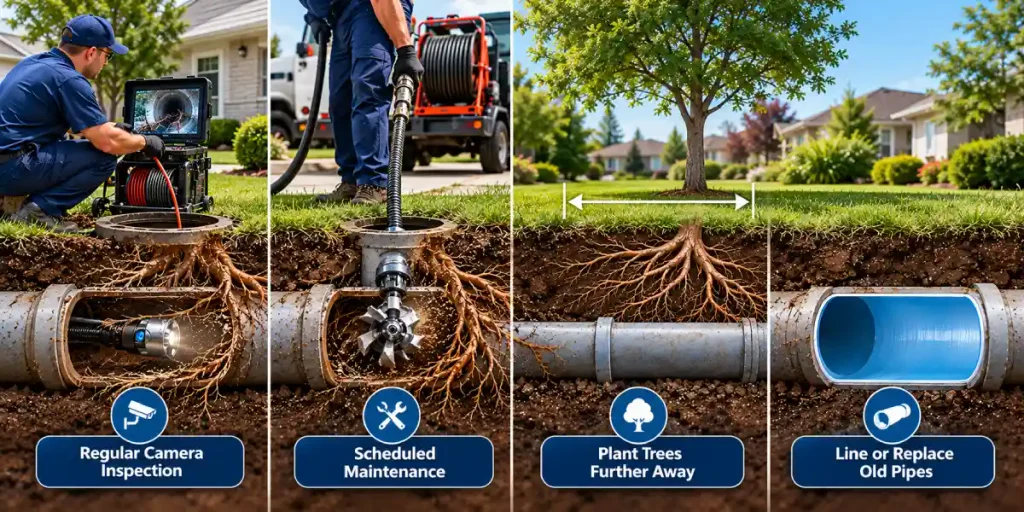
- Have the line camera inspected every couple of years if roots have been an issue before
- Book the maintenance cut ahead of the backup instead of after it
- Plant new trees away from the sewer line, and choose slower-growing types
- Line or replace old clay and cast iron instead of cleaning it every year
Many assume removing the tree will solve the problem. It usually does not. University of Arizona Cooperative Extension notes that roots can stay alive in the soil for some time after a tree comes down, so the pipe still needs fixing. In most cases, roots in drain lines are really a pipe problem, not a tree problem.
FAQs
How Do Tree Roots Get Into Sewer Lines?
They follow a leak. A cracked joint lets out a thin trickle, enough to keep the soil around it damp all summer. Fine root tips find that wet spot and nose their way in, sometimes from a tree across the yard.
How Do I Kill Tree Roots in Sewer Lines Without Harming the Tree?
You only need to hit the part of the root inside the pipe. Copper sulfate and sewer-grade foaming herbicides do just that. Have the clog cut out first, though. Poured onto a solid blockage, either product sits there.
Do Roots Grow Back After Removal?
They do, nearly every time. A cutter only shaves the roots back to the pipe wall. The crack they slipped through stays open, so a new clump tends to show up within a year or two.
When Should a Sewer Line Be Replaced Instead of Cleaned?
When cleaning stops buying you much time, roots back within a season is one clue. The camera gives you the other: pipe that is cracked, bellied, or caved in. At that stage, another cleaning is money better put toward a liner or new pipe.
How to Remove Tree Roots From a Septic Tank?
Leave it to a septic company. One wrong cut in a drain field line can get expensive. Between visits, a measured dose of copper sulfate flushed down the toilet keeps roots in check without upsetting the tank’s bacteria.
What Affects Roots in Pipes Removal Cost?
Every line is different, and a national average says little about yours. A short run with an easy cleanout and light roots costs far less than a long, packed line that ends in sewer line repair. A camera inspection gets you a real quote.
Will Vinegar Kill Tree Roots in a Sewer Line?
No, not in any useful way. Vinegar is a weak acid to begin with. By the time it mixes with the water already sitting in the line, very little of it is left, and certainly not enough to hurt a root. Rock salt does not work much better, and it can damage the soil around the pipe.
Final Thoughts
Most of what you need to know about how to fix roots in sewer line blockages comes down to order. First, have the line checked with a camera. Next, clear it with cutting and jetting. Then sit down with the footage. Some lines only need a cut every year or so. Others are cracked badly enough that a liner is the cheaper choice over time.
Repeat backups rarely fix themselves. Drain Pros Ventura will send a camera down the line and talk you through what it finds, cracks and all. The crew takes drain and sewer service calls all over Ventura County, out through the San Fernando Valley, and up into Santa Clarita.