
A main sewer line clog affects every drain in the house at once, and it can often be cleared with a mechanical drain snake run through the outside sewer cleanout. Unlike a single clogged sink or shower, a main line clog sits downstream of every fixture in your home, so it takes a different tool and a different approach to clear.
If the clog is caused by paper or soft debris, most homeowners can handle it themselves with the right equipment. But DIY clearing isn’t appropriate in every situation. If the clog is caused by broken pipes or thick tree roots, you need a professional to repair the pipe itself, not just heavier equipment to push through the blockage.
Signs You Have a Main Sewer Line Clog, Not a Single Drain Clog
The first step is to know if it’s truly the main sewer clog, not a single drain. Because the solution paths are different. Single clogging in a sink or shower will only impact that one. If a main sewage line clog problem, it’s going to be a problem for the whole house.
Signs of a Main Sewer Line Clog
- Multiple backed-up drains: If water backs up in the bathroom tub when you run the kitchen sink, the issue is in the main line.
- Gurgling sounds in the toilet: If there’s a blockage, trapped air escapes as bubbles and gurgling noise in the bowl.
- Water in a basement floor drain or shower: Water pooling in a basement floor drain or shower is a big red flag.
- Sewer odors: A sulfur or rotten-egg smell coming from drains throughout the house.
- Overflow at the cleanout: Water leaking from the white or black pipe cap in your yard.
Main Sewer Line Clog vs. a Single-Drain Clog
If many fixtures are affected at once, the clog is in the main line. If only your kitchen sink is affected, the clog is in that pipe. If every toilet in the house is slow to drain, that’s a main line clog.
What Causes a Main Sewer Line to Clog?
Understanding the cause helps you prevent the next one. The most common causes include:
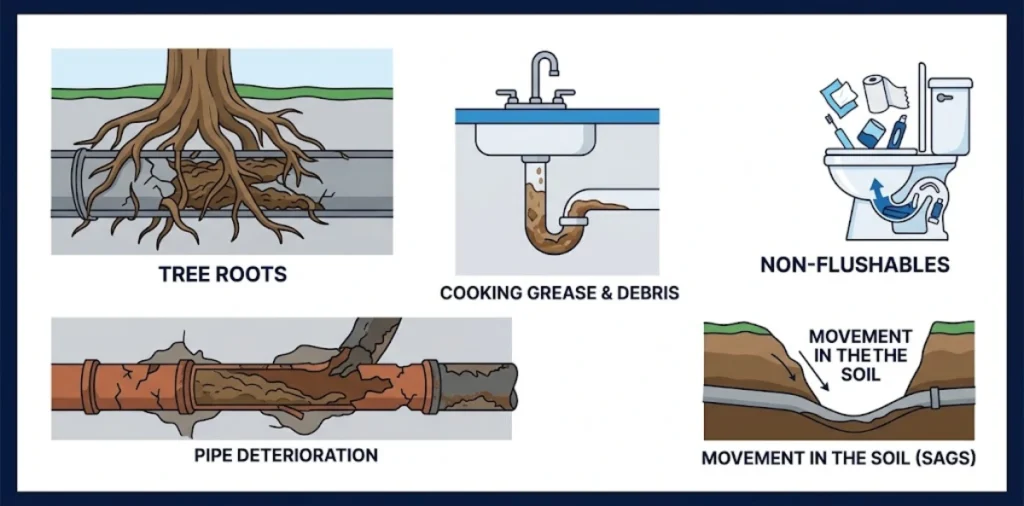
The most common causes include:
- Tree roots: Roots are drawn to moisture and can grow through small cracks in the pipe.
- Cooking grease and debris: Grease hardens inside the line, and debris gets lodged in it.
- Non-flushables: Wipes, paper towels, and hygiene products don’t break down.
- Pipe deterioration: Worn-out clay or cast iron pipes can crack or flake.
- Soil movement: Shifting soil can cause pipes to sag or develop a “belly.”
Why Does My Main Sewer Line Keep Clogging?
A recurring main line clog usually points to an underlying pipe issue, often a crack or a “belly” where waste settles and hardens over time. Clearing the blockage gives temporary relief, but it doesn’t fix the broken pipe underneath it.
What You Need to Clear a Main Sewer Line Clog Yourself
To clear a main line clogged with debris, you’ll need the right tools:
- Sewer cleanout access: Locate the entry point to the main line.
- Drain-cleaning equipment: A motorized sewer auger, typically rented from a hardware store, is necessary for main lines.
- Protective gear: Rubber gloves, boots, and a face shield.
- Containment materials: Buckets and towels to catch water when you open the cap.
Where Is the Sewer Cleanout?
A sewer cleanout is a capped pipe that gives direct access to the underground sewer line. It’s usually found in the yard near the foundation or close to the sidewalk. Working from the cleanout is a better option than removing a toilet to access the line, since it won’t risk flooding your bathroom floor with sewage.
How to Clear a Main Sewer Line Clog Yourself
Follow proper safety precautions first, then work through these steps:
1. Locate and Open the Sewer Cleanout
Once you find the cap, loosen it slowly with a pipe wrench. If water starts spraying out, stop. That means the line is under pressure. Let the water seep out slowly into a bucket before removing the cap fully.
2. Determine the Severity of the Clog
Look inside the pipe. If you see standing water right at the top, the blockage is significant. If you see dirt or rocks, the pipe may be collapsed. Forcing a snake into a collapsed pipe will only cause more damage.
3. Use a Drain Snake or Sewer Auger
Use a heavy-duty motorized auger with at least 50 to 100 feet of cable. Feed the cable into the cleanout toward the street.
4. Work the Blockage Until the Line Clears
When the snake hits resistance, move it back and forth so the cutting head can work through the debris. Avoid forcing the tool. Doing so can damage the pipe or jam the cable.
5. Flush the Main Sewer Line With Water
Once the water level in the cleanout drops, the clog has moved. Run a garden hose into the cleanout to flush out remaining debris, then go inside and test several fixtures to make sure they drain properly.
6. Confirm the Sewer Line Is Clear
Watch the cleanout while someone else flushes the toilets. Water should flow freely without rising back up. If you still hear gurgling, the clog is only partially cleared.
What Is the Best Way to Clean a Sewer Line?
The best DIY method depends on what’s causing the clog.
| Method | Best Suited For | Main Limitation |
|---|---|---|
| Plunger | Individual fixture clogs | Limited usefulness for deep main-line blockages |
| Drain snake/auger | Mechanical blockage removal | May not resolve damaged or severely obstructed pipes |
| Enzyme cleaner | Ongoing organic buildup | Not reliable for a severe blockage |
| Professional hydro jetting | Heavy buildup and certain recurring clogs | Requires specialized equipment |
| Camera inspection | Finding the cause of recurring problems | Inspects the problem; doesn’t remove the clog |
DIY Methods That May Not Clear a Main Sewer Line Clog
Many “home hacks” that work fine on a slow bathroom sink fail once the clog is deep underground in the main line. It helps to know why before you waste time on them:
- Baking soda and vinegar: This combination fizzes and can loosen light residue in a sink trap, but the reaction fizzles out fast and has nowhere near the force needed to move a blockage sitting several feet underground in a 4-inch pipe.
- Boiling water: Boiling water can melt light grease in a kitchen sink trap close to the surface, but by the time it travels through the pipe and reaches a main line clog, it has cooled to room temperature and lost any softening effect.
- Chemical drain cleaners: These are toxic to handle and dangerous to store, and they’re built for short, small-diameter pipes, not long underground runs. If the clog blocks the chemical from draining through, it just sits in the line and can eat away at metal or plastic pipe over time. Chemicals also make it harder and messier for a plumber to snake or camera the line afterward if you end up needing professional help anyway.
If a clog doesn’t respond to a mechanical snake or auger, none of these methods will succeed where the mechanical approach failed. At that point, the issue is almost always a structural one, like a collapsed pipe or root intrusion, rather than something a chemical or home remedy can dissolve.
What to Do If Your Main Sewer Line Is Still Clogged
If you’ve worked the auger through the line and the water still won’t drain, stop and don’t try to force it. Running more water into a blocked system just pushes it back up into your tubs, showers, and sinks instead of down the line. Here’s what to check before you try again:
- Re-check the cleanout. Confirm the water level in the cleanout is actually dropping. If it isn’t moving at all, the auger may not have reached the blockage.
- Look at what came back on the cable. Grease, paper, and soft debris usually mean the clog can still be cleared mechanically. Mud, gravel, or chunks of pipe material mean something more serious.
- Rule out a collapsed pipe or root ball. If the auger meets hard resistance in the same spot every time and won’t push through, you’re likely dealing with a collapsed section of pipe or a large root mass rather than a simple blockage.
- Stop before you make it worse. Repeatedly forcing a motorized auger against a collapsed pipe can widen the damage and turn a repair job into a full pipe replacement.
If none of this clears the line, it’s time to call a professional rather than keep working the same spot.
When a Main Sewer Line Clog Needs Professional Attention
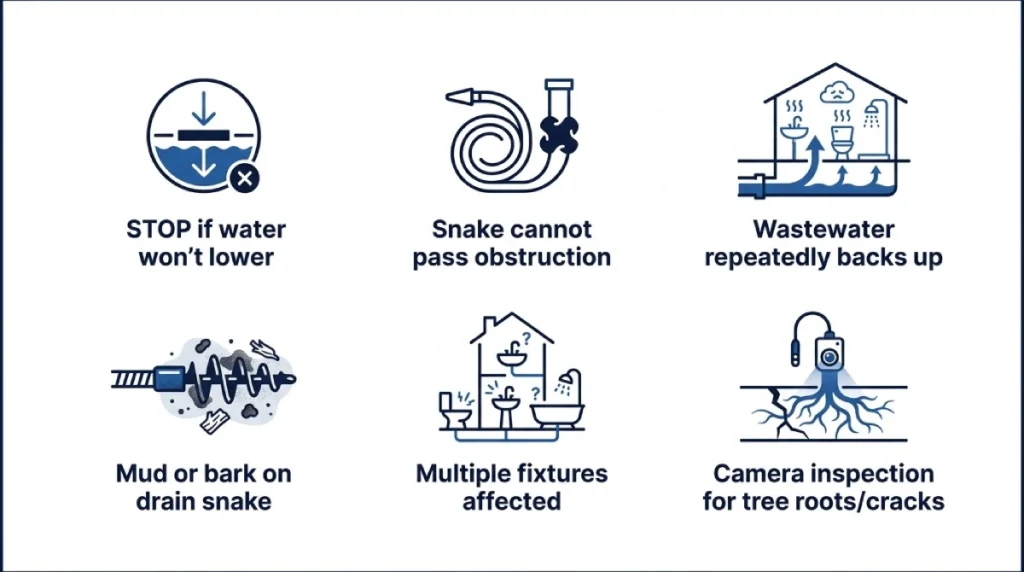
Some warning signs mean it’s time to stop the DIY approach and call a licensed plumber:
- The snake can’t pass through the obstruction. If the cable won’t advance past a certain point no matter how you angle it, something more than debris is blocking the line.
- Wastewater repeatedly backs up within hours of clearing it. A clog that returns fast usually means the underlying pipe is damaged, not just dirty.
- You see mud, gravel, or tree bark on the end of your drain snake. This is a strong sign of a cracked pipe or root intrusion, not a simple debris clog.
- Multiple fixtures remain affected despite your efforts. If toilets and drains are still slow after clearing what you can reach, the problem may be further down the line than a homeowner’s auger can get.
Any one of these is reason enough to bring in a professional with commercial-grade equipment and a camera to see what’s actually happening underground.
When Is a Sewer Camera Inspection Worth It?
A camera inspection is the only way to see exactly what’s happening inside a clogged sewer pipe instead of guessing based on symptoms. A plumber feeds a waterproof camera on a flexible cable through the cleanout and views the footage in real time, which can reveal:
- Tree roots growing into joints or cracks
- Cracked, corroded, or collapsed sections of pipe
- A bellied section where the pipe has sagged and collects waste
- Misaligned or separated joints
- Buildup of grease, scale, or debris along the pipe walls
A camera inspection is worth the cost any time a clog keeps coming back, when you’re buying a home with an older sewer system, or before agreeing to a major repair, since it tells you exactly where the problem is and how bad it is before you pay to fix it. That precision saves you from paying for repeated temporary fixes or digging up the wrong section of yard.
How to Keep Sewer Pipes Clean and Prevent Future Clogs
Most main line clogs build up slowly, which means a few consistent habits go a long way toward preventing them:
- Watch what you flush. Only flush human waste and toilet paper. Wipes, paper towels, and hygiene products don’t break down the way toilet paper does, even when the packaging says “flushable.”
- Manage grease properly. It’s tempting to pour grease down the sink, but it hardens as it cools inside the line and gradually narrows the pipe until it clogs. Let grease cool in a container and throw it in the trash instead.
- Catch problems early. Slow-draining sinks or tubs are often the first sign that something is building up in the line. Address them as soon as you notice them rather than waiting for a full backup.
- Control root intrusion. Avoid planting large trees or shrubs near your sewer line, since roots are drawn to the moisture inside the pipe and can grow into small cracks over time. If mature trees are already near the line, periodic root treatments can help.
- Schedule periodic inspections for older homes. If your home has clay or cast iron sewer pipe and is more than a few decades old, a camera inspection every few years can catch deterioration before it turns into an emergency.
Frequently Asked Questions
What can I do to determine if there is a plugged sewer?
Check for water backing up in several fixtures at once, such as a shower filling up when you flush the toilet. If only one fixture is affected, the clog is likely local to that drain rather than the main line.
Will a drain snake work to remove a clog in a main sewer?
Yes, but you’ll need a large motorized auger, not a hand-turned snake. A hand-turned snake doesn’t have the length or cutting power to reach or break up a clog several feet underground.
What will happen if sewage pipes get clogged?
Wastewater has nowhere to go and backs up into the lowest drains in your home, usually a basement floor drain or the lowest-set toilet. Left unaddressed, this can lead to sewage overflow and water damage.
What causes my main sewer line to get clogged?
The most common causes are tree root intrusion, grease buildup, non-flushable items, pipe deterioration, and soil movement that causes the pipe to sag. Older homes with clay or cast iron piping tend to see these issues more often than homes with newer PVC lines.
Do chemical drain cleaners harm a sewer pipe?
Yes. Left in the pipe too long, they can deteriorate PVC or corrode old cast iron. They can also make a follow-up snake or camera inspection messier and more hazardous for whoever ends up working on the line.
Final Thoughts
Unclogging a main sewer line yourself can be a manageable, cost-effective project, but it takes the right precautions and tools. If your main line clogs repeatedly, that’s a sign of a deeper issue, such as a cracked or bellied pipe, and it’s time to call a professional rather than keep clearing it yourself.