
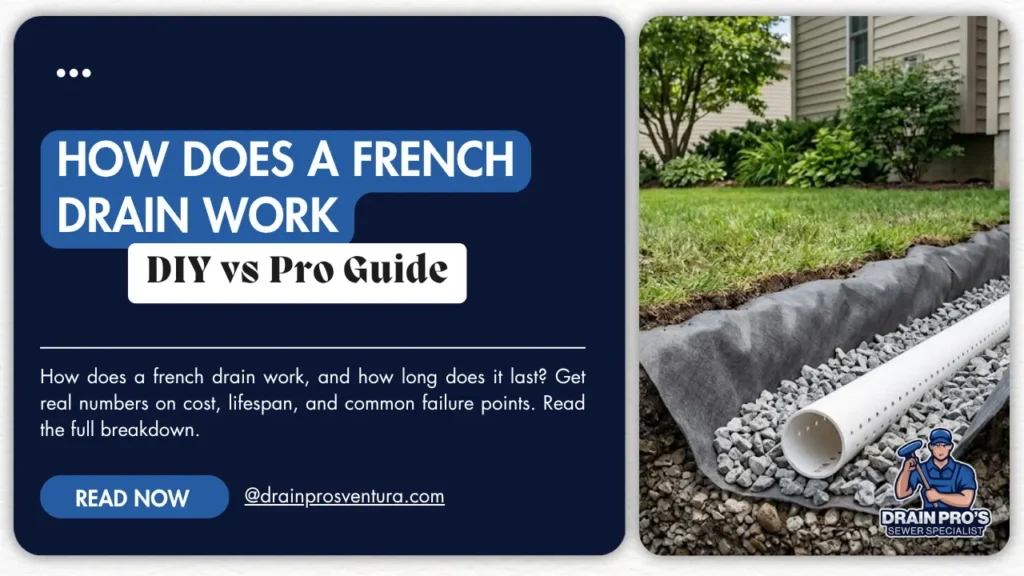
Imagine waking up to the sound of heavy rain. Instead of enjoying the cozy rainy day, your mind goes to the basement walls. That soft, marshy spot in the yard that never seems to dry. No matter how much we say water is life, from a homeowner’s perspective, uncontrollable water is enough to haunt the night. It rots wood, invites mold, and can even crack the very foundation holding your life together.
You need a solution that works with nature, not against it. That’s where a French drain comes to the rescue. Understanding how does a French drain works properly is the first step to battling the rainy season.
What is a French Drain System?
A French drain is basically a subsurface drainage system. This is designed in a way that moves water away from an area where it isn’t wanted, such as a waterlogged basement, patio, etc. To put it simply, it is a gravel-filled trench with a perforated pipe at the bottom. The perforated pipe acts as a subway where water moves to different places.
Many get confused with the name, thinking it came from France. Despite the name, the French drain didn’t come from France. It was popularized by Henry Flagg French, an American judge and farmer from Massachusetts, in his 1859 book Farm Drainage. He wanted a way to stop his fields from becoming swamps.
Today, a French drain is also known as a blind drain, a curtain drain, or a perimeter drain.
No matter the name, the goal is the same: move water from point A to point B using the power of gravity.
What Is the Purpose of a French Drain?
French drains are used mainly to control groundwater and channel it to a place where it will not cause problems for the structure or landscape. When you see water accumulating around the foundation or a lawn that remains “squishy” long after the rain, you will probably be asking yourself, “What does a French drain do? In simple terms, it is the underground guttering mechanism, which collects water before it can cause problems.
When considering what French drains are used for, there are three main scenarios where they become essential:
Protecting Foundations: These drains keep water away from your house’s foundation so that hydrostatic pressure is not a problem. This is the pressure that water exerts against your basement walls that causes cracks, bowing, and leaking.
Drying Out Soggy Lawns: French drains are a simple way for a soggy lawn to drain off excess water if the yard has low spots. This will not allow your lawn to develop “root rot” and will keep your yard in good condition.
Controlling Retaining Wall Pressure: Water is sometimes held up behind retaining walls. The French drain that is placed behind the wall removes that moisture, so that the heavy soil cannot push the wall over.
The final outcome is to prevent still water. You are ensuring that moisture has a clear path and will not walk on your walls, floor, or foundation, causing costly damage.
The Core Principle: How Gravity & Filtration Do the Heavy Lifting
Water is lazy. It always takes the path of least resistance and always flows downhill. This is basic physics. A French drain is smart enough to utilize this third-grade physics, aka gravity.
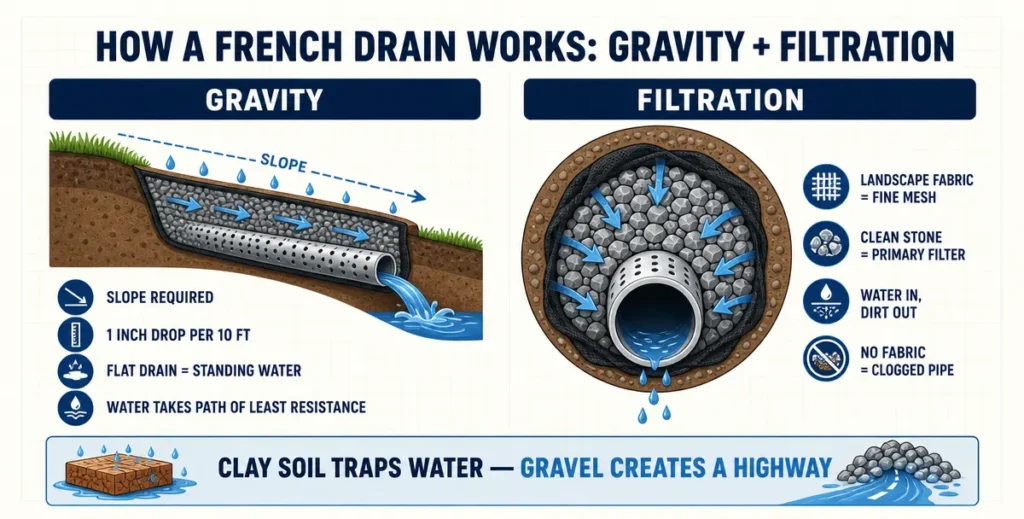
If your soil is thick clay, which is pretty common in the rainy season, the water gets trapped. A French drain is basically a highway for that trapped water. Because the trench is filled with loose gravel, water flows through the gravel more smoothly than through the surrounding dirt.
The Role of Gravity
For a French drain to work, it must be sloped. Water will just stand still in a flat drain. By tilting the pipe slightly downward—usually one inch of drop for every ten feet of length—gravity pulls the water toward the exit.
The Role of Filtration
If you just dug a hole and put a pipe in it, the pipe would fill with mud in a month. This is where filtration comes in. We wrap the pipe in landscape fabric and surround it with clean stone. The stone acts as a primary filter, and the fabric acts as a fine mesh. They let the water in but keep the dirt out.
French Drain Explained: The Four Essential Components
To build a drain that lasts thirty years instead of three, you need four specific parts working together.
1. The Trench
The trench is the “cradle” for your system. For most homes, the trench is about 12 to 18 inches deep and 10 to 12 inches wide. If you are protecting a foundation, it might need to go much deeper. The bottom of the trench must be smooth and consistently sloped.
2. The Perforated Pipe
This is the heart of the drain. You have two main choices for choosing a perforated pipe:
- Corrugated Plastic: Flexible, cheap, and easy to snake around corners. However, the ridges can catch sediment over time.
- PVC (SDR-35): Smooth on the inside, which helps water move faster and makes it easier to clean out. It is more expensive and harder to install but lasts longer.
3. Gravel and Aggregate
The gravel provides the open space for water to move. Experts recommend using clean, washed stones. Most pros use 3/4-inch crushed stone or river rock. Small “pea gravel” is okay for small projects, but larger stones allow for faster water flow.
4. Landscape Fabric
You line the trench with this fabric before adding stone. Once the pipe and stone are in, you fold the fabric over the top. The landscape fabric prevents the soil above from washing down into the rocks and clogging the system.
If you’re comparing drainage options for your property, our guide to French drain vs. channel drain explains how these systems differ and which situations each is best suited for.
Interior vs. Exterior French Drains: Which One Do You Need?
The decision between an interior or exterior system will depend on the water’s location.
Exterior French Drains
These are installed in your yard or along the outside of your foundation.
Ideal for: Waterlogged lawns, waterlogged after rain, or to keep water from ever getting to basement walls.
The Work: Quite a bit of digging is involved. Bushes, decks, or sidewalks may need to be cleared.
Maintenance: Easier to get to if a problem arises, but more susceptible to getting clogged by tree roots.
Interior French Drains
They’re placed underneath your floor in your basement or crawlspace.
Suitable for: Basement leaks or situations in which digging is not possible outside of the house (such as houses set in a hill).
The Work: A contractor uses a jackhammer to break the edge of the concrete floor, and then re-creates the concrete.
The Logic: It allows you to know that water could get under your floor and provides it with a path to a sump pump before the water can invade your basement.
The Decision Tree:
- Is your yard a swamp? Go for Exterior.
- Is your basement floor wet but the yard is fine? Interior is ideal here.
- Is your foundation wall bowing or cracked? Both. You need to stop the pressure outside and manage the moisture inside.
Where Do French Drains Drain To? Understanding Discharge Options
A drain that doesn’t lead anywhere is just a long puddle. You must have a “discharge point.”
- Daylight Discharge: The drainage pipe is put beside a hillside where the ground drops away. As there are no moving parts, daylight discharge is the cheapest and most reliable method.
- Dry Well: An underground plastic tank surrounded by stone. The water fills the tank and slowly soaks into the deep soil. This is great if you have a flat yard.
- Sump Pump: If your yard has no slope, you must use a pump. The drain leads to a basin, and the pump pushes the water up and away to a better spot.
- Storm Drain: Some cities allow you to hook your drain into the street’s storm sewer. Warning: Always check local laws; doing this without a permit can lead to massive fines.
French Drain Lawn Drainage: How to Calculate Slope, Depth, and Gravel Size
If you are a DIYer, don’t guess. Use these standards to ensure your hard work pays off.
The 1% Rule
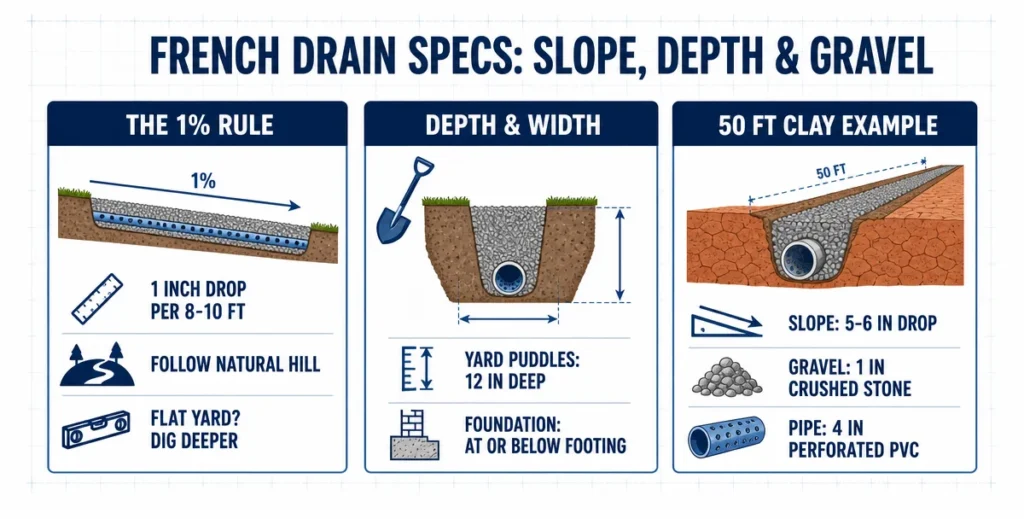
Your drain must drop at least 1 inch for every 8 to 10 feet of horizontal run. If the ground is naturally sloped, follow the hill. If the ground is flat, you must dig deeper as you go to create an artificial slope.
Depth and Width
For surface water (yard puddles), a shallow trench of 12 inches is fine. To protect a foundation, the drain should be level with or slightly below the “footing” (the base of your wall).
Example Scenario
Imagine a 50-foot path in clay soil.
- Slope: The end of the pipe should be 5 to 6 inches lower than the start.
- Gravel: Use 1-inch crushed stone. Clay doesn’t drain well, so you need larger gaps in your stone to move water quickly.
- Pipe: Use a 4-inch perforated PVC pipe for better durability in heavy clay.
Step-by-Step Installation (Professional & DIY Reality Check)
Installing a French drain is simple in theory but exhausting in practice.
- Location: Mark your path with marking paint. Never skip this.
- Grading: Check your slope with a string level or a laser level.
- Trenching: Dig the trench. Renting a “trencher” machine will save your back, but it won’t work in rocky soil.
- Fabric: You need to line the trench with a landscape fabric. The non-woven type fabric is more suited for this job. Leave plenty of extra fabric on the sides to fold over later.
- Gravel Base: There should be at least 2 inches of gravel in the base.
- Pipe: Lay the pipe with the holes facing down. Many people think holes go up, but water fills from the bottom of the trench first.
- Backfill: Cover the pipe with more gravel, fold the fabric over, and top with a few inches of topsoil or decorative stone.
Common DIY Mistakes:
- Holes facing up: This allows the pipe to fill with silt faster.
- No fabric: Dirt will eventually fill the gaps between your rocks, turning your drain into a solid block of mud.
- Wrong slope: If the water stays in the pipe, it will eventually rot your foundation or attract mosquitoes.
Why French Drains Fail (And How to Prevent It)
Even a well-built drain can fail. Here is what to watch for:
Clogging from Silt
If the landscape fabric tears or wasn’t used, fine dirt particles will settle in the gravel.
- Prevention: Use high-quality, non-woven geotextile fabric. It feels like felt rather than plastic.
Root Infiltration
Tree roots love water. They will find the holes in your pipe and grow inside, acting like a hairball in a shower drain.
- Prevention: Keep drains at least 10 feet away from large trees. If you must go near one, use a solid pipe in that section or a root barrier.
Crushing
If you use thin, cheap corrugated pipe and then drive a truck over it, the pipe will collapse.
- Prevention: Use Schedule 40 or SDR-35 PVC pipe under driveways or areas with heavy traffic.
Long-Term Maintenance: Cost, Lifespan & When to Replace
A French drain is not a “set it and forget it” system.
Annual Check-up
Locate your discharge area each spring. Remove leaves, nests, or debris. Pour a bucket of water in the sump if you have a sump pump to be sure it will start.
The 20-Year Mark
A typical French drain will last from 15 to 30 years. Even the best fabric will allow some silt to pass through over time. If the yard is getting soggy again or the basement is getting humid, it could be time to end the life of the system.
Repair vs. Replace
Repair: If only the outlet is blocked, a plumber’s snake or high-pressure hose may be used to unclog it.
Replace: If the pipe has broken or the whole gravel block is dirty, it’s necessary to excavate it and build again. Once the dirt gets into the gravel, there is no simple way to “clean” it up.
French Drains vs. Other Drainage Solutions
Not every water problem needs a French drain. There are many other drainage solutions available too. Take a glance at them-
| Solution | Best For | How it Works |
| French Drain | Groundwater / Soggy Soil | Collects water from below the surface. |
| Sump Pump | Basement Flooding | Actively pumps water out of a pit. |
| Surface Drain | Puddles on Patios | A grate that catches water on top of the ground. |
| Grading | General Runoff | Changing the slope of the dirt so water rolls away. |
| Dry Well | Flat Yards | A holding tank that lets water soak into the earth. |
Although both systems are designed to manage water, understanding the differences between a French drain and a trench drain can help you choose the right drainage solution for your property. Read our guide to French drain vs. trench drain to compare their purposes and uses.
Soil Type & Climate: Does a French Drain Work in YOUR Yard?
Your local environment changes how you should design your drain. A French drain might be perfect for one home, but give bad results in yours. It all depends on the soil type and climate.
The Clay Challenge
The most frequent cause of French drains failing is clay soil. Clay is very dense, so water flows through it slowly. With heavy clay, you will need a wider trench and lots of gravel, so the water has somewhere to go.
The High Water Table
A French drain may fill with water year-round if you are in a low-lying area that is constantly wet. In this case, the drain is not only for water from the rain, but also to control the natural water table in the earth. A sump pump will be needed to “lift” the water out of the system almost certainly.
Cold Climates
The “frost line” is significant in Minnesota or Canada. When water is allowed to stand still in your pipe and freezes, it can break the pipe or form an ice dam.
Solution: Make sure it is sloped straight with no water standing in the pipe or, if possible, bury the discharge point below the frost line.
Landscape Integration: Making a Functional Drain Invisible
No need to compromise on your attractive yard and its drain.
The Grass Approach: 3-4 inches of topsoil may be placed on top of the fabric and grass planted. Simply keep in mind that the vegetation growing over the drain may dry out quicker than the rest of the lawn during a drought.
The Dry Creek Bed: Don’t cover up the drain; use it as an accent. Top the trench with lovely river rocks to form a pretty “stream” which will only run when it rains.
Pop-up Emitters: At the end of the pipe, use a pop-up emitter. It remains level with the grass, allowing the mowing machine to pass over it, and when it rains, the water pressure raises the lid to allow water to escape.
Cost Breakdown: Installation, Materials & Regional Variation
How much should you budget?

DIY Costs
If you do the work yourself, you are mostly paying for materials and machine rental.
- Pipe: $50–$150 depending on type.
- Gravel: $30–$50 per ton (you may need several tons).
- Fabric: $50–$100.
- Trencher Rental: $150–$300 per day.
- Total: Roughly $500–$1,000 for a standard 50-foot run.
Professional Costs
A professional crew brings expertise and heavy machinery. They also handle the disposal of the dirt they dig up (which is a huge task).
- National Average: $25 to $50 per linear foot.
- Total: Roughly $2,500–$5,000 for a 50-foot run.
- Variables: If they have to cut through a concrete driveway or hand-dig around gas lines, the price will go up.
Interior French Drains for Basements: Special Considerations
If you are dealing with a wet basement, the “interior” version is your best friend.
How It Works
Contractors remove a 12-inch strip of the concrete floor along the perimeter. They place a special low-profile drain on top of the footing. They often drill “weep holes” into the bottom of the hollow cinder blocks of your wall. This lets water trapped inside the walls drain into the pipe.
The Sump Pump Connection
Unlike an exterior drain, an interior drain almost never “daylights.” It always leads to a sump pit. A high-quality pump is non-negotiable here. We recommend a pump with a battery backup, because heavy rains often come with power outages.
Finishing
Once the pipe is in, the contractor pours new concrete over it. Once it dries, you can lay carpet or tile right over it. The system is completely invisible and silent.
FAQs
How long does installation take?
For a professional crew, a standard backyard drain takes 1 to 2 days. For a DIYer working on weekends, expect it to take 3 to 4 days of hard labor.
What if my French drain never fills with water?
This is actually a good thing. It means your soil is absorbing the water naturally, and the drain is only there as a safety net for extreme storms. If the area stays dry, the drain is doing its job.
Can I add a French drain if my house is already built?
Yes, most French drains are “retrofits.” It is very common to add them to older homes as the landscape settles or the climate changes.
Do I need permits for a French drain installation?
Usually, you don’t need a permit for a simple yard drain. However, if you are connecting to a municipal storm sewer or if the work changes the flow of water onto a neighbor’s property, you must check with your local building department.
What if my neighbor’s drainage affects me?
Water law is tricky. Generally, a neighbor cannot “collect and discharge” water onto your property in a way that causes damage. A French drain can be a great way to catch that water at the property line and move it safely away.
How do I know if my French drain is clogged?
Look for the signs you had before the drain was installed: standing water, a musty basement, or water bubbling up from the ground near the trench. You can also run a garden hose into the intake; if water doesn’t come out the discharge end quickly, you have a blockage.
Will a French drain prevent basement flooding 100%?
Nothing is 100% in nature, but a properly designed French drain combined with a sump pump is the gold standard. It handles the vast majority of groundwater issues that cause basement flooding.
Final Thoughts
Water is a persistent force. It doesn’t sleep, and it doesn’t give up. But with a French drain, you aren’t fighting the water; you are simply giving it a better place to go. Whether you spend a weekend digging in the dirt or hire a professional team, the peace of mind that comes with a dry home is worth every penny. When the next storm rolls in, you won’t be checking the basement with a flashlight—you’ll be sleeping soundly, knowing your home is protected.