
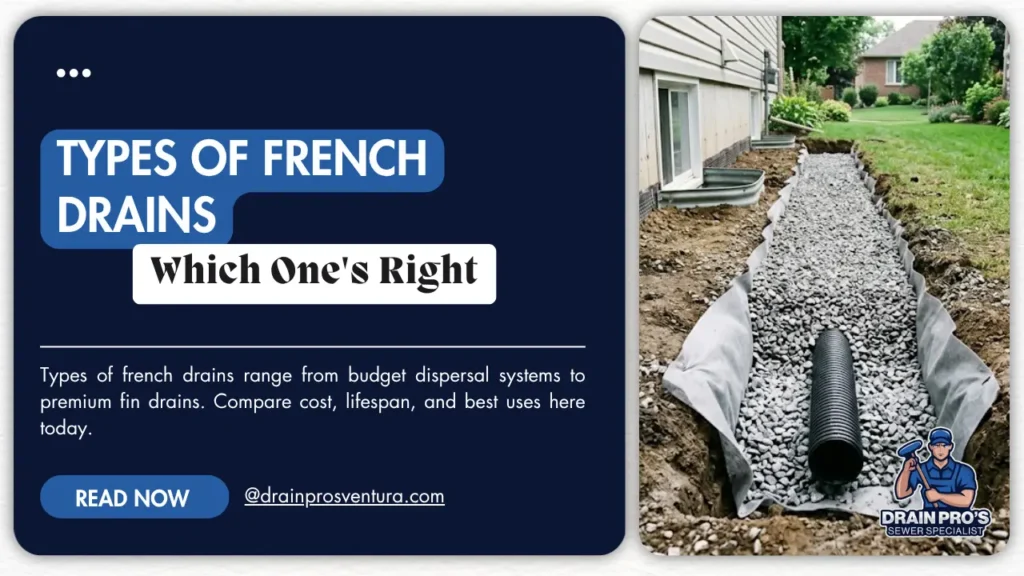
A French drain is a subsurface drainage system with a gravel-filled trench and a perforated pipe to transport groundwater away from a home’s foundation or low-lying yard areas. You may think a “French drain” is a single, one-size-fits-all product. But we recognize that there are actually 14 types of French drain systems tailored to specific soil types, slopes, and moisture levels. Choosing the wrong types of French drain will cost you a flooded basement and a wasted fortune.
This guide is not your typical listing of French drain types. We’ll break down what materials actually hold up over time and which professionals you should trust to move the earth around your home.
How Many Types of French Drains Are There?
In the professional drainage industry, there are 14 recognized French drain types. Don’t mistake these systems for just “ditches with rocks”; these variations in French drains are engineered to meet the specific demand. Generally, French drainage systems fall into three buckets:
- Residential Foundation & Yard Drainage: The most common interior, exterior, perimeter, surface, and blind drains fall into this category.
- Specialty & Commercial Systems: These cover trench, filter, dispersal, slope, and sump-pump-integrated systems.
- Premium & Alternative Options: These involve fin drains, slot drains, threshold drains, and curtain drains.
A quick word of advice: don’t get hung up on the names. You might hear a contractor call a “curtain drain” an “interceptor drain”, they are the same thing. What matters is the physics of how the water moves.
Different Types of French Drains by Location: Where Water Enters
Before picking a pipe, you have to identify the “entry point.”
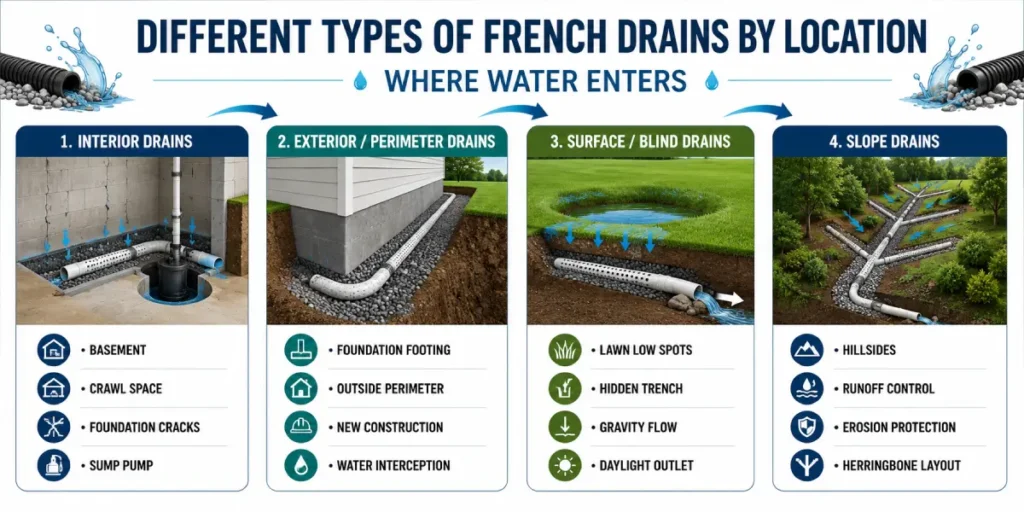
Water usually attacks a property in one of four ways:
- Interior Drains: As the name suggests, interior drains are installed along the inside perimeter of a basement or crawl space. Water seeps through foundation cracks; the drain collects it via trenches. Because these sit below the outdoor grade, professional drainage experts usually integrate a sump pump to actively push water out.
- Exterior/Perimeter Drains: Having a new construction or major foundation repair? The exterior drains are best suited for you. By digging down to the foundation footing outside the house, we intercept water before it ever reaches the basement.
- Surface/Blind Drains: If your lawn feels like a sponge, a shallow “blind” drain uses a skillfully hidden subsurface trench to pull water from low spots without a visible grate. The water flows via gravity to a “daylight” outlet ( Extending the drain pipe to the surface)
- Slope Drains: Think of a slope drain as a “herringbone” shield that catches runoff moving downhill before it turns your backyard into a mudslide or erodes your landscaping. Absolutely necessary for a hilly area or a slope-y patio.
All 14 French Drain Types Explained
As mentioned above, engineers have modified the basic French drain into different types of French drain systems, according to special needs or environment.
1. The Traditional French Drain
This is the original: a gravel-filled trench with a perforated pipe laid at the bottom. It relies entirely on gravity; no pumps are required if you have a downhill outlet. It is the industry standard for exterior foundation and yard applications, typically offering a lifespan of 15 to 30 years.
2. Curtain/Interceptor Drain
A curtain drain is a shallow, uphill drain installed to intercept groundwater before it reaches your property. It essentially acts as a border wall for water. Sometimes it happens that your neighbor’s home is built on a higher area than yours; in that case, a curtain drain is your best friend for keeping your yard from becoming their runoff basin.
3. Interior French Drain
This is a perimeter drain installed inside the basement or crawl space. The interior drain runs around the walls at floor level. That’s why weep holes are drilled into the foundation wall to let trapped water into the trench, which then flows to a sump pit. As there is no gravity outlet in an interior French drain, a pump is mandatory. Otherwise, the water won’t move, which is basically the main point.
4. Exterior/Foundation French Drain
This requires deep excavation around the foundation footing, often 3 to 5 feet down. It is a preventative install during new construction or significant foundation work. The best part is, you can even pair an exterior French drain with exterior waterproofing membranes. It will stop water from entering the basement before it even touches the concrete.
5. Trench Drain (Linear/Surface Drain)
Unlike a buried pipe, a trench drain is a visible, linear channel covered by a metal or plastic grate. You’ve likely seen these at the end of driveways or on patios. They are designed to catch high volumes of surface runoff quickly before the water can flow into a garage.
6. Filter Drain
A filter drain uses a sophisticated multi-layer aggregate system—starting with fine sand and moving up to large river rocks. The goal is to strain out sediment and silt before the water reaches the pipe. These are common around retaining walls where soil erosion could easily clog a standard drain.
7. Dispersal French Drain
A dispersal drain is a “closed-end” system with no exit pipe. Instead of carrying water away, it allows the water to slowly soak back into the ground through the trench walls. This is the most budget-friendly option, but it only works in [City, State] if your soil is sandy and permeable.
8. Slope/Hill Drain
Slope drains are diagonal trenches cut into hillsides to prevent erosion. By using a “herringbone” pattern (main line with smaller branches), we can stabilize a muddy hill and prevent the soil from slumping toward your home during heavy rains. It requires precise grade math to ensure water doesn’t pool.
9. French Drain + Sump Pump System
In areas with high water tables or flat land where gravity can’t help, a sump pump is mandatory. The drain collects the water, and the pump mechanically ejects it to a safe discharge point. It adds cost, but it provides a level of certainty that gravity-only systems can’t match in clay-heavy soils.
10. Perimeter Drain
A perimeter drain is a specialized exterior system that wraps entirely around the footprint of a building. It’s a “premium” setup often installed during the initial build to ensure that no side of the foundation is left vulnerable to groundwater pressure.
11. Surface Water Drain
Surface water drains use catch basins—essentially underground boxes with grates on top—to collect water from parking lots or low spots in a lawn. These feed into a solid pipe that carries the water to a storm sewer. They require regular cleaning to prevent leaves from clogging the grates.
12. Slot Drain
A slot drain is a modern, aesthetic version of a trench drain. Instead of a wide grate, it has a narrow slit (only 2-4 inches wide) that can be tiled flush with a patio or walkway. It’s sleek, nearly invisible, and perfect for high-end residential landscaping.
13. Threshold Drain
A threshold drain is a specialized system installed directly at a doorway or garage entrance. Its sole job is to prevent water from “puddling” at the door and eventually seeping under the weather stripping and into your home.
14. Fin Drain
A fin drain uses a thin, permeable composite membrane instead of a bulky gravel trench. It’s a space-saving alternative that works wonders behind retaining walls or on golf courses. It’s incredibly durable, with a lifespan that can reach up to 50 years.
Choosing the Right Drain Type: Decision Framework
If you are feeling overwhelmed, use this quick cheat sheet to narrow down your needs:
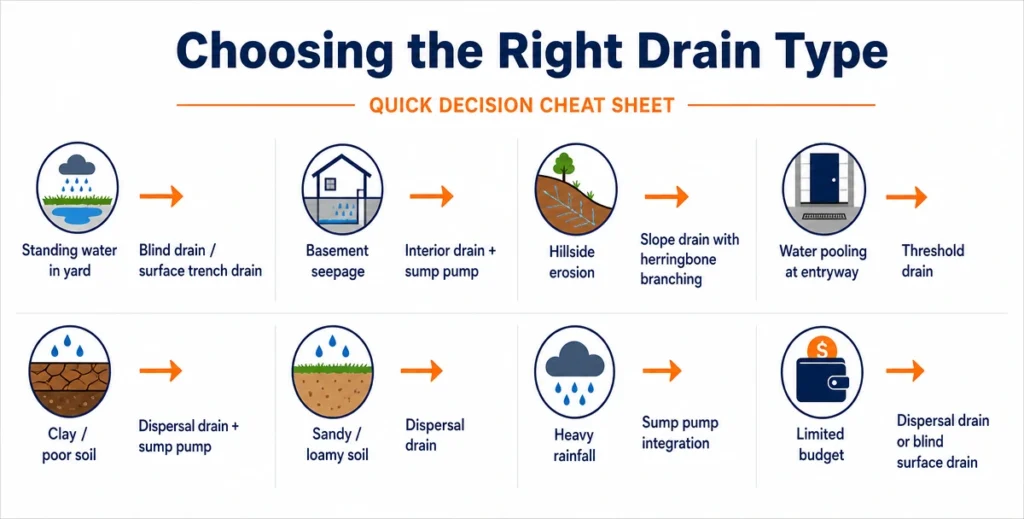
- Standing water in your yard? → Blind drain (subsurface) or surface trench drain.
- Basement seepage? → Interior drain + sump pump.
- Hillside erosion? → Slope drain with herringbone branching.
- Water pooling at entryway? → Threshold drain.
- Poor soil permeability (clay)? → Dispersal drain + sump pump or trench drain to storm outlet.
- Sandy/loamy soil? → Dispersal drain (water infiltrates naturally).
- Heavy rainfall area? → Sump pump integration (gravity alone won’t cut it).
- Limited budget? → Dispersal drain (cheapest) or blind surface drain.
What Type of Gravel for French Drains?
Most contractors don’t talk about the rocks, but the gravel is what actually does the work. Using poor-quality gravel can damage your expensive foundation or patio. That’s why knowing what type of gravel for a French drain is highly important for your household.
| Drain Type | Ideal Gravel/Stone | Size | Why |
| Traditional French Drain | Crushed Stone #57 | ¾–1″ angular | Locks in place; doesn’t shift; allows water flow. |
| Curtain Drain | River Rock or #57 blend | 1–1½” | Better filtration; shallow trench needs stability. |
| Interior Basement Drain | Crushed Stone #57 | ½–¾” | Fits floor space constraints in tight basements. |
| Filter Drain | Multi-layer: pea gravel → #57 → river rock | Progressive 1–2″ | Best for sediment filtration. |
| Dispersal Drain | Crushed Granite | ¾–1″ angular | Allows infiltration; long-lasting hardness. |
| Slope Drain | Crushed Granite | ¾–1″ | Angular edges resist settling on a steep grade. |
| Exterior Foundation Drain | Crushed Stone #57 or Crushed Granite | ¾–1″ | Stability under the weight of the foundation. |
| Perimeter Drain | Crushed Stone #57 | ¾–1″ | Industry standard; handles footing loads. |
Critical rule: Avoid pea gravel alone (it compacts too easily) and round river rock alone (it creates gaps that trap soil). Always pair round stones with angular crushed stone. Washed stone is non-negotiable; it prevents fine dust from clogging the perforated pipe.
What Type of Rock/Stone for French Drains?
Choosing the rocks for French drains depends on the use case, and sometimes the aesthetic appeal also factors in for luxury household or commercial areas.
- River Rock: Naturally rounded and aesthetic, but gaps can trap sediment. Best as a top decorative layer.
- Crushed Granite: The premium choice. It’s hard, angular, and resists erosion for 50+ years. Best for slopes.
- Crushed Limestone: Softer and can erode over decades in acidic soil. We generally don’t recommend it as a primary layer.
- Bluestone: Visually striking but comes with a premium price tag.
- Crushed Stone (#57, #4): The affordable industry standard. It’s the most cost-effective for traditional drains.
Material pairing rule: For the best results, combine two types: 60% angular crushed stone (for structure) and 40% river rock (for the top visual layer).
French Drain Pipe Types & Materials
Pipe selection matters as much as the gravel. Here’s the breakdown:
Perforated Pipe Options:
- Corrugated: Flexible and cheaper, but harder to clean. Good for tight spaces.
- Rigid PVC: Much stronger and handles foundation weight better, but requires precise digging.
Perforation Patterns:
- Bottom-half perforations: The standard for traditional drains where water enters from below.
- Top-half perforations: Used in interior drains where water seeps in from the sides.
Diameter Sizing:
- 4″ standard: Used for most residential drains.
- 6″ large capacity: Necessary for high-volume commercial or exterior drains.
What Type of Contractor Installs French Drains?
Not all contractors are specialised in French drain installation. Just like the materials, choosing the best contractor matters for the lifespan of the drainage system.
- French Drain Specialists: Call [Brand Name] for complex systems and sump pump integration. We’ve installed hundreds of these and know how to diagnose the root cause.
- Landscapers: Best for yard surface drains and grading. Don’t hire them for interior basement work.
- Basement Waterproofing Companies: The only choice for interior drains. They integrate the system with vapor barriers and sealants.
- Foundation Repair Contractors: Best if you are already doing structural work. They can handle the deep excavation for perimeter drains.
- Plumbers: Good for the sump pump plumbing itself, but they usually don’t handle the trenching or gravel work.
What Is the Difference Between a French Drain and a Field Drain?
While both systems are designed to manage excess water, a French drain is a specific type of trench containing a perforated pipe surrounded by gravel used primarily to protect residential foundations, whereas a field drain (or agricultural tile drain) is a larger-scale network of buried pipes used to lower the water table across expansive farmland.
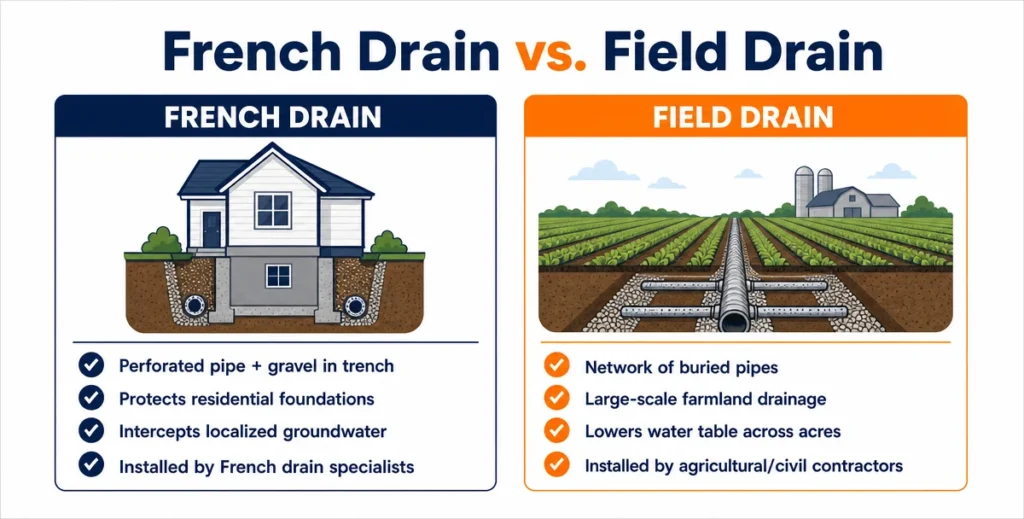
French drains focus on intercepting localized groundwater near structures. Field drains are engineered to improve soil trafficability and crop health over several acres. French Drain specialists or landscapers typically install French drains for homeowners to prevent basement flooding, while field drains are the domain of civil engineers and large-scale agricultural contractors.
Cost & Performance Comparison Table
You certainly don’t want the hassle of installing one French drain twice in five years, right? That’s why you must compare the cost and performance of various types of French drainage systems. Only choosing the cheapest one might cost you a fortune in the next year.
| Drain Type | Typical Cost (per ft) | Difficulty | Maintenance | Capacity | Best Soil | Lifespan |
| Traditional | $20–30 | Moderate | Low | Medium | Loam/Sand | 15–30 yrs |
| Interior | $25–35 | Hard | Medium | High | Any | 20–35 yrs |
| Exterior | $30–40 | Hard | Low | Medium | Loam | 25–40 yrs |
| Dispersal | $12–20 | Moderate | Low | Low | Sand | 20–30 yrs |
| Slope | $15–25 | Moderate | Moderate | High | Any | 15–25 yrs |
| Fin Drain | $25–35 | Moderate | Very Low | Medium | Any | 25–50 yrs |
Conclusion
You can’t choose a French drain type based on the name only. Matching the drain to your water problem, soil, and budget is part of the selection. Start with location and water volume. Then pick the contractor type that specializes in that installation. Finally, specify the gravel and pipe materials for longevity.
Use the decision framework in this guide to narrow your options. When you call contractors, tell them what type of drain you think you need and ask them to confirm. The right specialist will validate your thinking or explain why a different type fits better. Most importantly: don’t skip the gravel selection. It’s the difference between a drain that works for 20 years and one that clogs in 5.
Frequently Asked Questions
What is the cheapest type of French drain?
The dispersal drain is typically the most affordable, costing between $12 and $20 per linear foot. However, it only works if your soil can naturally absorb the water; it is not a solution for heavy clay areas.
Can I mix river rock and crushed stone?
Yes. We recommend doing 60% crushed stone for the structural bottom and 40% river rock for the top. Crushed stone alone looks industrial, while river rock alone settles too much and creates gaps.
Do I really need a sump pump for interior drains?
Yes. If your basement is below grade, gravity cannot pull the water out to the street. Without a pump, water will simply back up into the pipe and flood your floor.
How much gravel do I need for a French drain?
You can use the formula: (Length × Width × Depth) ÷ 27 = cubic yards. For a 50-foot trench that is 2 feet wide and 2 feet deep, you will need approximately 7.4 cubic yards of gravel.
How long does a French drain last?
A traditional system usually lasts 15 to 30 years. Premium options like fin drains can last up to 50 years. The lifespan depends heavily on soil type and whether you use washed stone.