
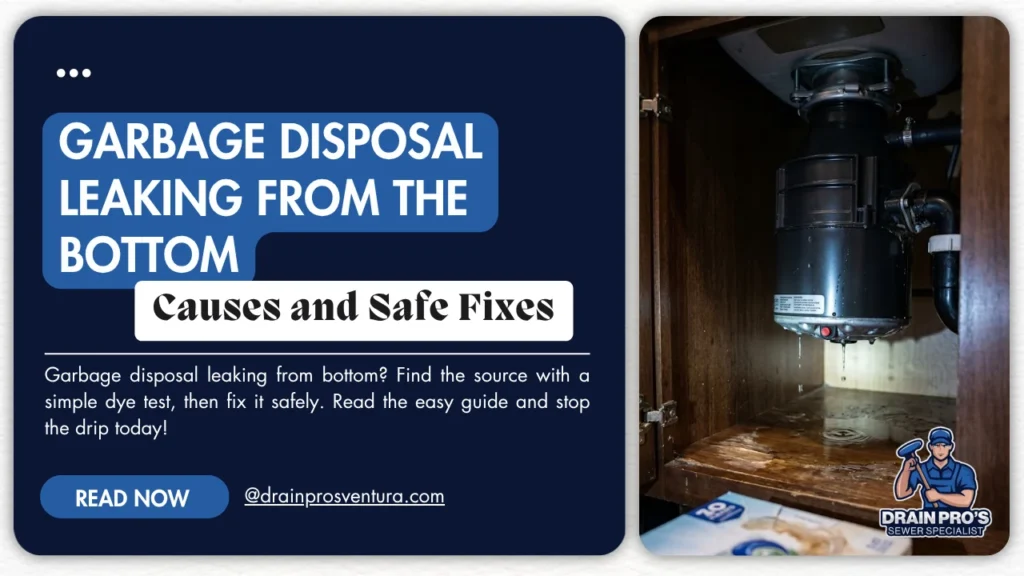
It usually starts with a damp cabinet floor. A box of dish pods gone soft at the corner, a puddle that keeps coming back however many times you wipe it up, and eventually a drip hanging off the underside of the unit.
The question everybody asks at that point is whether it can be saved. A garbage disposal leaking from the bottom is not a single fault, which is what makes it worth a few minutes of investigation. Some leaks begin up the sink and run down the housing. Others come from inside the motor compartment. A garbage disposal dripping under the sink tells you very little until you find where the water starts.
Safety First: Cut the Power
Before anything else, kill the power at the circuit breaker, or pull the plug if the unit runs off an outlet inside the cabinet. Water sitting near a motor and its wiring is a shock risk, and the Electrical Safety Foundation International treats keeping water away from electrical equipment as a basic rule of home safety.
Stay off that side of the sink as well. Switching the disposal on to see how bad the leak is only sends more water where it should not be.
What Causes a Garbage Disposal to Leak From the Bottom?
Several joints hold a disposal together, and any of them can let water past. Gravity does the rest, pulling every leak down to the lowest point, which is why so many of them look identical from the cabinet floor. Plumbers split the causes into two: connection leaks, which are repairable, and internal failures, which are not.
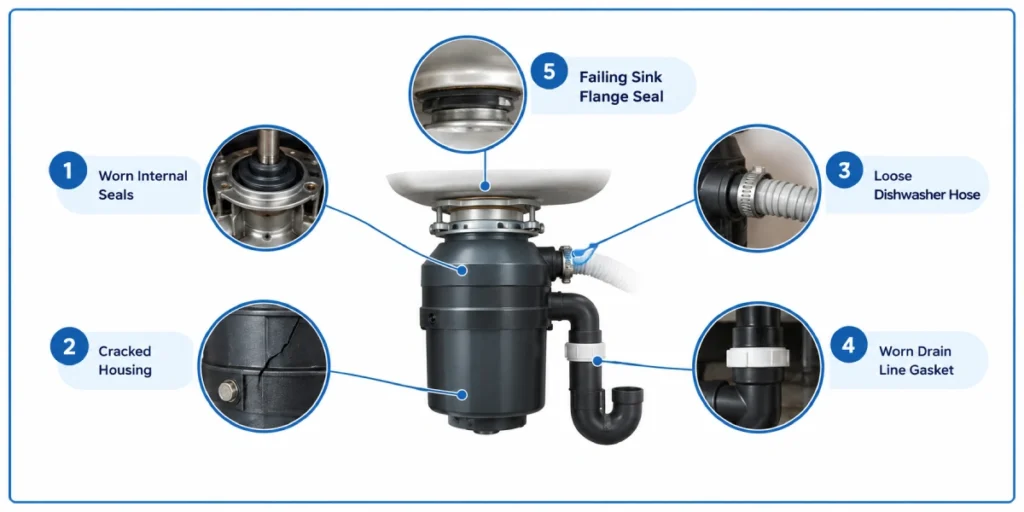
Worn Internal Seals
Water showing up near the reset button or the base plate is the one that rules out a cheap repair. When a garbage disposal is leaking at the bottom in that spot, the seals protecting the motor from the grinding chamber have worn through, and years of hot water and vibration are usually behind it. Household models are not built to have those seals swapped out.
Cracked Housing
A cracked housing is the other reason a garbage disposal is leaking out of the bottom. It might be a hard fruit pit, a spoon that went in unnoticed, or nothing more dramatic than corrosion inside an older unit. Once water is seeping through the wall itself, no sealant holds it for long.
Loose Dishwasher Hose
Your dishwasher drains through a hose clamped to the side of the disposal, and clamps work loose over time. When that happens, water runs down the outside of the unit with every cycle. The garbage disposal drips from the bottom edges while the disposal itself is in perfectly good order.
Worn Drain Line Gasket
Ground food leaves through the discharge tube, which meets the sink drain at a joint sealed by a rubber gasket. Rubber hardens and cracks eventually. Water then slips out of that joint and travels down the housing, leaving a garbage disposal dripping from bottom surfaces that had nothing to do with it.
Failing Sink Flange Seal
Right at the top sits the sink flange, the metal ring joining the disposal to the sink, sealed with plumber’s putty that dries out after several years. Water creeps past the ring and runs the length of the unit. What looks like the bottom of the garbage disposal leaking is, in this case, a problem that started above the sink.
How to Find Where the Leak Starts
Tracing a leaking garbage disposal from bottom up saves you from replacing a unit that only needed a clamp. InSinkErator advises ruling out the higher connections before assuming the unit has failed, and the test below takes about fifteen minutes.
- Cut the power at the breaker.
- Dry the disposal and every pipe near it.
- Lay newspaper or paper towels across the cabinet floor.
- Fill the sink with a few inches of water and add food coloring.
- Pull the stopper and watch each joint as it drains.
- Run the dishwasher on its own and check the hose connection.
Dye appearing only at the base points to a true garbage disposal leak from bottom seals. A disposal dripping from bottom edges during dishwasher cycles, and at no other time, is the hose clamp instead.
Leak Location Guide
Where the water shows up narrows the cause down quickly. The table pairs each leak point with its likely source and the repair that goes with it, following the patterns that come up most in home kitchens.
| Where Water Appears | Likely Cause | Typical Fix |
|---|---|---|
| Top, near the sink | Dried flange putty | Reseal the sink flange |
| Side, at the drain pipe | Worn discharge gasket | Replace the gasket |
| Side, at the dishwasher hose | Loose or rusted clamp | Tighten or replace the clamp |
| Bottom, near the reset button | Failed internal seals | Replace the unit |
| Through the wall of the unit | Cracked housing | Replace the unit |
Designs vary between brands and models. If your leak does not match any row here, the owner’s manual or a licensed plumber will get you further than guesswork.
How to Fix a Garbage Disposal Leaking From the Bottom
Which repair you need depends entirely on the source. Connection leaks tend to be short jobs using basic tools and cheap parts. Internal leaks are another matter, because the motor compartment is sealed at the factory and was never meant to be opened at a kitchen table. Power stays off throughout.
Tighten the Dishwasher Hose Clamp
Plenty of cases where a garbage disposal leaks from bottom edges come down to this one clamp. Tighten it with a screwdriver until it is snug, stopping short of crushing the hose, and replace it outright if there is rust. Then run a cycle and press a dry paper towel to the joint.
Replace the Discharge Gasket
Undo the bolts or clamp holding the discharge tube and pull it clear of the unit. Fit a gasket made for your model, then reattach the tube evenly so it does not sit at an angle. For most homes, that is enough to stop a garbage disposal leaking at the drain joint.
Reseal the Sink Flange
Loosen the mounting ring and lower the disposal, keeping a hand underneath, because these weigh more than people expect. Scrape the old putty away, press a fresh rope of plumber’s putty under the flange, and reinstall. The same repair clears up what looked like a leaky garbage disposal bottom.
Replace the Unit When the Body Leaks
If the garbage disposal is leaking from the bottom itself, through the reset button or base plate, there is no sensible repair. Tape and epoxy patches fail within weeks, and worse, they hide water damage while it builds up inside the cabinet.
Should You Repair or Replace Your Disposal?
Age carries as much weight as the leak. Family Handyman, citing a licensed plumber, puts the working life of a well-maintained unit at five to ten years. Once a disposal is leaking from the bottom at that sort of age, replacing it is the better use of money, since seals tend to fail in sequence rather than one at a time.
A younger unit with a connection leak deserves the repair. Check the warranty first as well, because manufacturers cover more than people assume.
How to Prevent Future Leaks
Daily habits protect the seals more than anything else does. InSinkErator recommends keeping fats, oils, and grease out of the unit altogether and running a strong stream of cold water while grinding.
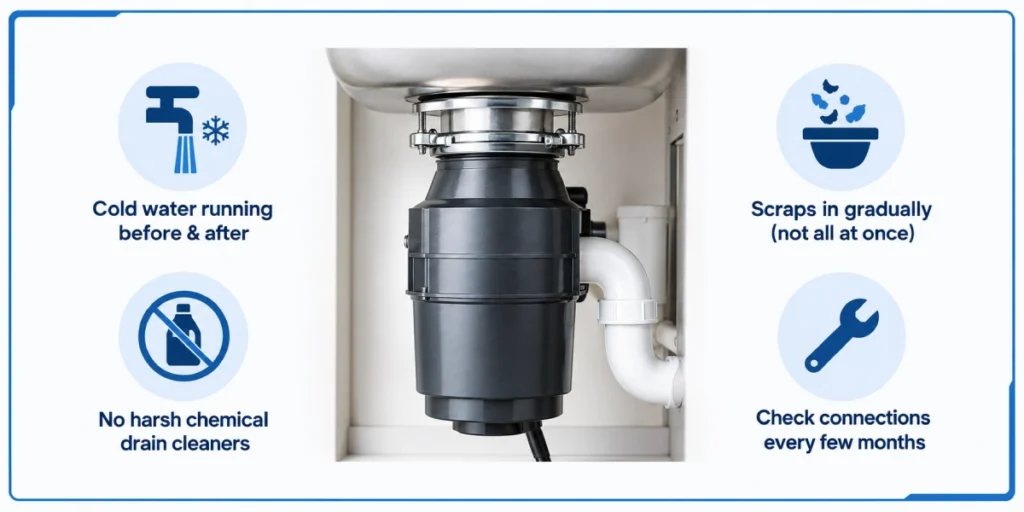
A few more steps help.
- Cold water running through the grind and for several seconds afterward
- Scraps fed in gradually instead of all at once
- No harsh chemical drain cleaners
- A look at the connections under the sink every few months
Grease is a problem well past the disposal itself. The U.S. Environmental Protection Agency warns that fats poured down a drain clog household plumbing, and worn seals remain the leading cause of a garbage disposal leaking water from bottom surfaces, so anything that slows that wear is time well spent.
Garbage Disposal Leaking From the Bottom: FAQs
A leaking garbage disposal can be caused by anything from a loose connection to an internal seal failure. Before replacing the unit, these frequently asked questions can help you identify where the water is coming from, whether it’s safe to use the disposal, and what steps to take next.
My Garbage Disposal Is Leaking From the Bottom. Can I Still Use It?
Better not to. Water around the motor is a shock hazard, so leave the power off and use the other side of the sink until the leak has been dealt with.
Is a Garbage Disposal Dripping Water From Bottom Surfaces Always a Sign of Failure?
Not at all. Water from the flange, the drain gasket, or the dishwasher hose runs down and drips off the base, which makes the unit look guilty. Dry everything and find the highest wet point before deciding.
Why Is a Brand New Disposal Leaking?
On a recent installation, the fault is nearly always the installation itself, usually an uneven flange or a drain connection left loose. Both are quick to put right, and the warranty may well cover the visit.
Can You Fix a Garburator Leaking From Bottom Seals?
Garburator is the term used across much of Canada for the same appliance. A garburator leaking from the bottom seals has the same internal failure as any other brand, so replacement is the usual answer.
Final Thoughts
A garbage disposal leaking from the bottom does not always mean the unit is finished. Loose clamps and dried-out putty send water down the housing all the time, and both are straightforward fixes. An internal leak is the exception, and replacement is the safe answer there.
When the source will not reveal itself, or the cabinet floor has already taken on water, a licensed plumber can check the disposal and the drain line in the same visit. Drain Pros works with homeowners across Ventura County, the San Fernando Valley, and Santa Clarita on leaking disposals and kitchen drain service.