
Two properties on the same street can flood in completely different ways. One pools at the low corner of the driveway after twenty minutes of rain. The other shows nothing for years, then a baseboard goes soft, and the culprit turns out to be groundwater that has been pressing on the footing the whole time.
Same rain, two very different problems. That is why the types of stormwater drainage systems worth installing have no single answer.
What works comes down to things no photo shows: where the water collects, what your soil will take, and how much arrives in the first fifteen minutes of a storm. So the options below are sorted by the job each one does.
The Three Jobs Any Drainage System Has to Do
Stormwater drainage only ever does three things. It moves water somewhere else, or holds it back for a few hours, or puts it into the ground. Most systems get built around one of those and then borrow from another.
Hardly any property gets by on a single approach. A driveway drain moves water into a pipe. The pipe carries it to a basin that holds it. The basin then lets it go slowly, or lets it sink into the ground where it sits.
Problems start when one job gets skipped, which is how a perfectly good channel drain ends up emptying straight against a neighbor’s fence.
Surface Systems: The Types of Stormwater Drainage Systems You Can See
These sit at grade and catch water the moment it arrives. Cheap to inspect, because you can see them. Easy enough to clear with a shovel and a bucket.
When a yard starts holding water after every storm, this is where anyone sensible looks first. Most of what sits on a residential or commercial lot lives in this group, and no two are interchangeable.
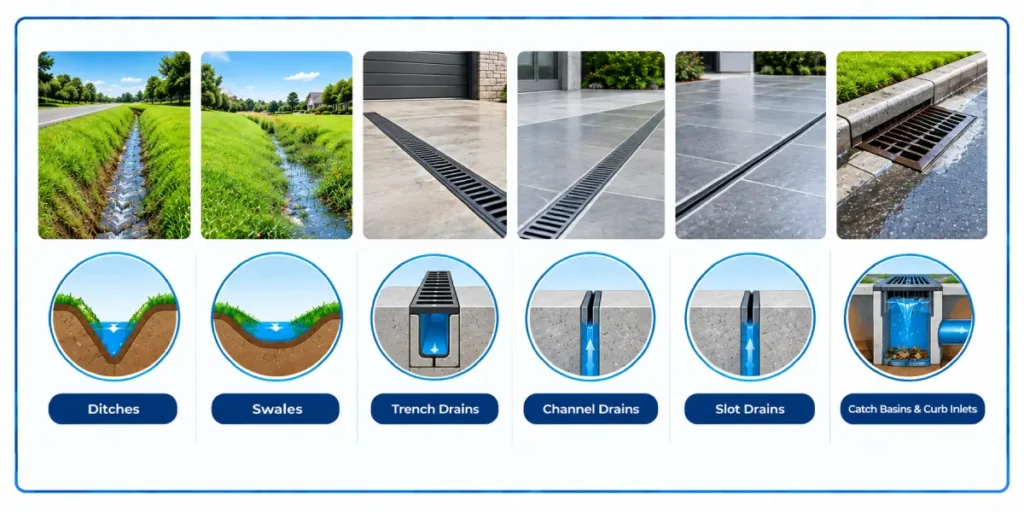
Ditches and Swales
ditch is an open channel, usually V-shaped, cut along a road edge or a property boundary, and it works for the simple reason that water runs downhill.
A swale does similar work but shallower and wider, with something growing along the bottom, so the flow slows and part of it soaks away while it travels.
The catch with swales is that they want space and forgiving soil, and a narrow lot tends to offer neither. A ditch needs little more than a slope and clearing now and then.
Trench and Channel Drains
Picture a narrow slot cut straight across a driveway, lined, then capped with a grate. That is a channel drain. It catches sheet flow before the water reaches a garage door or a building threshold.
Slot drains do the same job through a thin surface opening rather than a wide grate. Cleaner to look at, but quicker to block under heavy leaf fall.
Catch Basins and Curb Inlets
A curb inlet pulls water off the street. Underneath sits a catch basin, a chamber with a sump that holds grit and debris back before the water moves into the pipe. Let the cleaning slide and the sump pack solid.
At that point, the basin has stopped doing the one job it was installed for.
Subsurface Systems: Drainage You Never See
Surface drains only help once water has reached the surface. A good share of drainage trouble stays underground, where saturated soil leans on footings and keeps a crawl space damp through the season.
A buried storm drain system deals with that, intercepting water inside the soil and carrying it off before it ever reaches the structure.
French Drains
A perforated pipe, wrapped in filter fabric, buried in a gravel trench. Water moving through the surrounding soil finds the gravel, drops into the pipe, and leaves by gravity.
These work well along foundations and at the foot of a slope. They also silt up when the fabric or the gravel is wrong for the soil, which is the usual reason an older one quits.
Dry Wells and Soakaways
A dry well is a buried chamber that takes a concentrated flow, usually off downspouts, and lets it seep out into the ground around it.
During a storm, it buys time. Set one in tight clay, though, and it fills and stays full, so a percolation test counts for more than the size of the tank.
Storage and Green Storm Drainage Systems
Bigger sites cannot just push water downstream, so the storm drainage system has to hold some back. A detention basin sits dry between storms, fills, then releases slowly over hours.
A retention basin keeps a permanent pool. Both cut the peak flow that floods everything downhill, and both get sized by an engineer against a design storm.
Newer sites soak water in rather than pipe it away. The US Environmental Protection Agency calls the pipes-and-basins hardware gray infrastructure, and the soak-it-in approach green infrastructure.
Permeable paving lets water pass through into a gravel bed below. A bioswale is a planted channel that carries and filters runoff at once.
A green stormwater drainage system usually combines a few of these, and the EPA’s list of green infrastructure types is longer than most owners expect.
Storm Water Drainage System Design: What Decides the Right Fit
None of this gets picked from a catalogue. The types of storm water drainage system that hold up are chosen against the site, not the brochure.
How fast water shows up. Where it is allowed to go once you have collected it, which is a legal question as much as an engineering one. And what the ground will absorb, which a percolation test settles in an afternoon. Get those wrong, and the best product on the market still floods.
| System | Works best for | Watch out for |
|---|---|---|
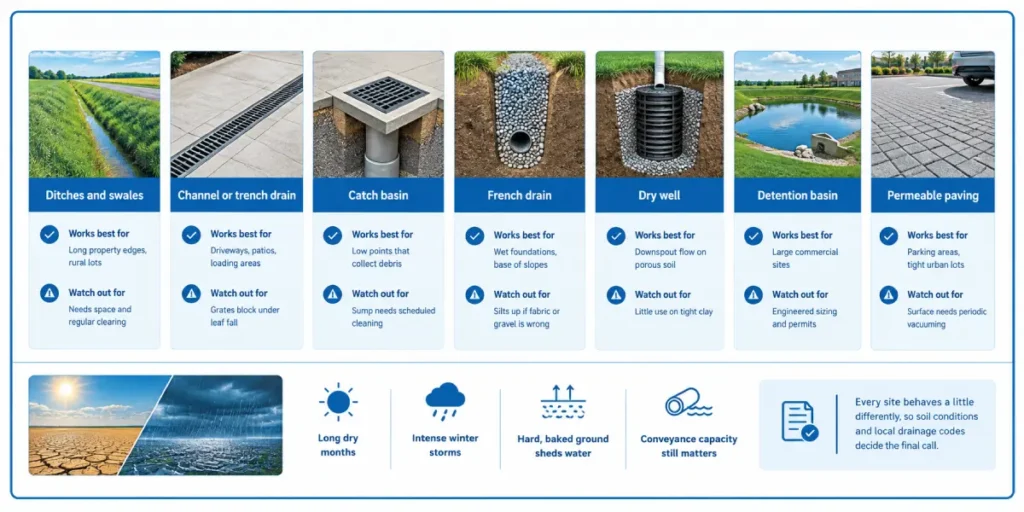
| Ditches and swales | Long property edges, rural lots | Needs space and regular clearing |
| Channel or trench drain | Driveways, patios, loading areas | Grates block under leaf fall |
| Catch basin | Low points that collect debris | Sump needs scheduled cleaning |
| French drain | Wet foundations, base of slopes | Silts up if fabric or gravel is wrong |
| Dry well | Downspout flow on porous soil | Little use on tight clay |
| Detention basin | Large commercial sites | Engineered sizing and permits |
| Permeable paving | Parking areas, tight urban lots | Surface needs periodic vacuuming |
(Every site behaves a little differently, so read this as a starting point rather than a specification. Soil conditions and local drainage codes decide the final call.)
Around Ventura County, the pattern is long dry months, then a handful of intense winter storms. Ground that has baked hard since spring sheds that first heavy rain almost the way pavement does, which is why infiltration-only designs disappoint here and why conveyance capacity still earns its keep.
Stormwater Drainage FAQs: What You Need to Know
Choosing the right drainage system involves more than simply moving water away from your property. From maintenance and combined drainage solutions to permits and discharge requirements, these FAQs cover the practical questions homeowners and property managers often have about stormwater drainage.
What is the most common type of stormwater drainage system?
On built-up lots, it is the buried piped setup: surface inlets and catch basins feeding underground pipe that ends at a street drain or a basin. Popular for obvious reasons. It shifts a lot of water quickly, and you never have to look at it. The downside arrives later, because when something goes wrong, it goes wrong where nobody can see.
How much cleaning does a drainage system need?
Twice a year covers most properties, once going into the wet season and once coming out of it. Heavy tree cover changes that, sometimes to quarterly. Sumps and grates fill faster than people believe, and a catch basin sitting full of sediment protects nothing at all. It is a hole in the ground with a lid on top.
Can different types of drainage be combined on one property?
Most of the time they have to be. A downspout feeds a dry well, a channel drain across the driveway ties into a buried line, a swale takes the back slope. The handoff is where these go wrong. Every piece needs an outlet that can accept what is being sent to it, or you have relocated the flooding rather than solved it.
Do you need a permit to install a drainage system?
For anything discharging off your own property, or on a commercial site, assume yes until someone tells you otherwise. Municipal systems fall under EPA stormwater permitting, and cities and counties set their own rules on connections, easements, and where an outfall is allowed to sit. One phone call before the digging starts saves a great deal of trouble.
Final Thoughts
Sort the types of stormwater drainage systems by job rather than by product and the choice gets much simpler. Most working sites end up using two approaches, not one. And when a system does fail, the reason is usually dull. It was handed a job nobody designed it for, like a dry well taking roof water on clay.
Standing water on your Ventura County property? Or a drain that used to keep up and no longer does? Drain Pros Ventura covers drainage inspection, cleaning, and repair through Ventura County, the San Fernando Valley, and Santa Clarita, catch basins and buried lines included. Better to find the trouble in October than during the first real storm.